From Scroll → Chat → Checkout (₹1,000–₹5,000 Products)
A Practical Playbook for Emerging Marketers
Let’s start with something familiar.
You’re scrolling Instagram.
You see a Reel for a product priced at ₹2,499.
It looks interesting.
But you don’t buy immediately.
You:
- read the comments
- check the brand’s profile
- search for reviews on YouTube
- ask a quick question on WhatsApp
- then decide whether to buy
This is not overthinking.
This is normal buying behaviour today.
And if you’re a marketer, this one behaviour explains why many campaigns struggle to convert.
Because most funnels are built for clicks.
But customers need confidence.
Why ₹1,000–₹5,000 Is the Sweet Spot (And Why It Needs Smarter Marketing)
If you work with Indian D2C or ecommerce brands, most of your products likely fall into this range.
Fashion. Beauty. Home. Gifting. Gadgets. Accessories.
This mid-ticket segment often drives 40–50%+ of total D2C transactions.
But here’s the challenge:
These products are:
- not cheap enough for impulse buying
- not expensive enough for deep research
So customers hesitate.
They want reassurance before spending.
Which means:
👉 Your job as a marketer is not just driving traffic.
Your job is removing doubt.
Quick reflection:
👉 Does your current funnel help customers feel confident or confused?
The Buying Loop People Actually Follow
Most brands still think like this:
Ad → Website → Buy
But real buyers behave differently:
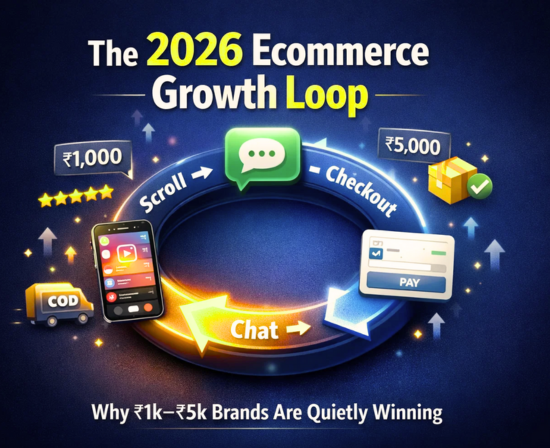
See content → Check proof → Ask questions → Buy → Return later
In simple words:
Scroll → Chat → Checkout
Here’s what the data shows:
- Only 10–15% of visitors convert on their first visit
- Buyers usually need multiple touchpoints (6–9 interactions)
- Assisted chats (like WhatsApp) can improve conversions by 20–40%
So expecting one Reel or one ad to sell instantly is unrealistic.
Ask yourself:
👉 Are you designing for real behaviour or ideal behaviour?
1. Social Media = Window Shopping (Attention Only)
As a marketer, stop expecting Instagram to close sales.
Social media is discovery.
Think of it like a mall display.
People:
- scroll
- browse
- save
- compare
Very few buy instantly.
So your goal here is not selling.
It’s building familiarity and trust.
What works better than promotional posters:
- demos
- real usage
- testimonials
- UGC
- before/after content
Because people trust people more than ads.
Quick check:
👉 If someone clicks your Reel today, do they clearly understand what you sell within 10 seconds?
If not, they leave.
2. Your Landing Page Decides Conversions (Not Your Ads)
Good ads bring traffic.
Good pages bring sales.
After someone clicks, they immediately look for answers:
- What is the price?
- Is cash on delivery available?
- How long will delivery take?
- Can I return it?
- Are there reviews?
If they don’t see this quickly, they exit.
Brands that simplify landing pages often see:
👉 20–30% lower drop-offs
Always send traffic to:
- focused product pages
- bestsellers pages
- bundle offers
- or WhatsApp chat
Not your homepage.
Ask yourself:
👉 Is your landing page answering questions or creating more confusion?
3. YouTube Builds Trust (Where Decisions Happen)
For ₹1k–₹5k products, people research before buying.
They actively search:
- “Is this worth it?”
- “Review in India”
- “Best under ₹____”
- “Comparison”
That’s high-intent traffic.
And it lives on YouTube.
YouTube doesn’t create impulse.
It creates belief.
Which is why users who watch reviews often convert better later.
As a marketer, create:
- honest reviews
- product demos
- comparisons
- problem-solving videos
Then repurpose them into Shorts and Reels.
One video. Multiple platforms.
Smarter effort.
Quick thought:
👉 If someone searches your product on YouTube today, would they trust what they find?
4. WhatsApp = Your Highest-Converting Channel in India
This is the biggest opportunity many marketers ignore.
India has 500M+ WhatsApp users.
And customers feel more comfortable chatting than checking out instantly.
They want to ask:
- Which option is right for me?
- What is the delivery timeline?
- Is COD available?
- Which size or variant should I choose?
When you respond clearly and quickly, hesitation disappears.
Brands using WhatsApp effectively often report:
👉 20–40% higher conversions
👉 fewer COD rejections
👉 better repeat purchases
Use it as:
- Click-to-WhatsApp ads
- product page chat buttons
- quick replies
- follow-ups
Think of WhatsApp as a digital store assistant.
Ask yourself:
👉 Are you using WhatsApp only for support or as an active sales tool?
5. Proof Beats Pretty Content (Always)
Another common mistake:
Too much aesthetic content.
Too little proof.
Pretty posts get likes.
Proof gets sales.
Follow this rule:
70% proof
30% aesthetics
Use:
- real customers
- testimonials
- demos
- reviews
- UGC
Because people trust other buyers more than brands.
Check yourself:
👉 Does your content show real results or just good design?
A Simple 2026 Checklist for Marketers
If you’re starting out, keep it simple.
Every week
- 4–6 short-form videos (proof-focused)
- 1 review or demo video
Every month
- 2–3 optimized landing pages
- Click-to-WhatsApp ads
- testimonials and UGC
- post-purchase follow-ups
Consistency beats complexity.
Final Thought
Ecommerce growth in 2026 will not come from shouting louder.
It will come from making customers feel comfortable buying from you.
The marketers who win will:
- reduce confusion
- answer doubts
- guide customers step-by-step
Not just push ads.
Remember the flow:
Scroll → Chat → Checkout
Design around this, and conversions become predictable—not random.
One last question:
👉 Which part of your current funnel needs the most improvement right now?