
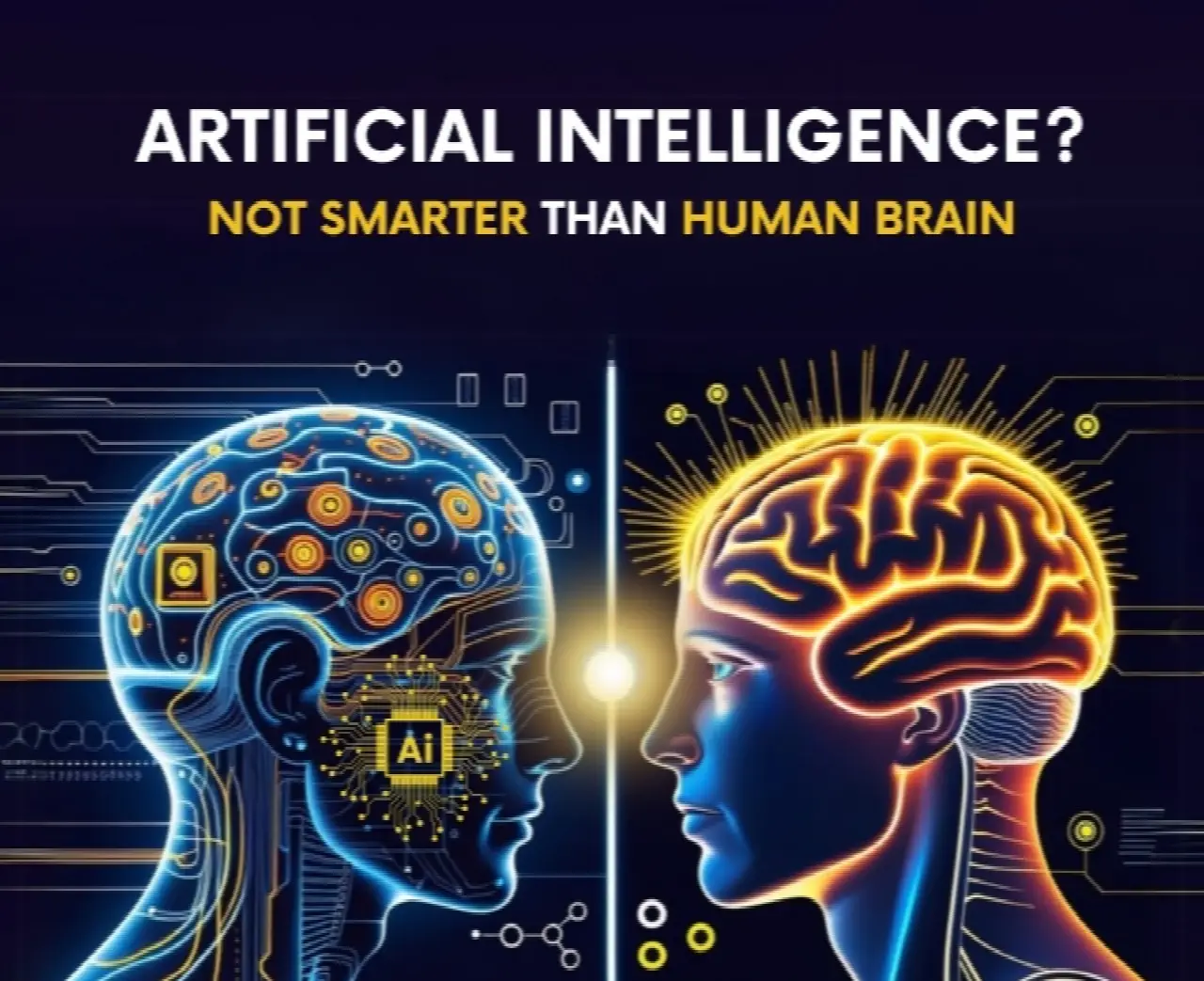
Picture a world where computers can think, learn, and reason—sounds like science fiction, isn't it? However, Artificial Intelligence (AI) is already transforming industries and changing our lives. As AI keeps growing, one question comes to mind: Can it ever become more intelligent than the human brain?
While AI can indeed process tons of data in mere seconds and solve complex problems instantaneously, is it even conceivable that it might achieve the depth, creativity, and emotional wisdom of the human mind?
In this article, we will explain why, in spite of all its breathtaking accomplishments, Artificial Intelligence is still inferior when it comes to being "smarter" than the human brain.
In the past few years, we have seen AI grow to a level that we don't even realize.
. If we watch carefully, we will understand that we are already surrounded by AI in nearly all walks of life. For example, chatting using ChatGPT or other similar apps like Gemini and DeepSeek indicates how rooted AI has become in our lifestyles.
Different issues can be resolved in different ways with the help of AI. But even then, we believe that AI is more powerful than our brains. But the human brain, which is underestimated most of the time, has its own charm and unmatched strength.
Can AI Truly Outsmart the Human Brain?
When it comes to important areas like copywriting, Click-Through Rate (CTR) optimization, and generating creative marketing ideas, the answer is a resounding no. Even with the technological progress in AI, there are critical areas of digital marketing where human emotional intelligence and creativity dominate. Let's discover why the human brain still has the upper hand in these important marketing areas.
Understanding the Human Brain
The human brain is a God-granted and extremely powerful tool that, if properly utilized, can reshape the world. It makes us think, perceive, and collect an immeasurable number of experiences. It is made up of gigantic complexity.
Did you know? The human brain weighs about 2.35% of the body's total weight.
With some 86 billion neurons, the brain not only recollects and is analytical but also understands emotions, locates surroundings, and adjusts to new environments in a matter of seconds.
We can dream, imagine, develop creative ideas, and show empathy—all qualities that AI has only the most superficially mimic.
AI vs. Human Brain: The Creativity Divide
AI can gather data, identify patterns, and execute tasks. However, it lacks something crucial in the world of marketing: creativity.
Creativity isn't just about producing content; it's about crafting messages that resonate with people on a deeper level. Here's why the human brain remains the ultimate champion:
Understanding Emotions and Nuance
While AI can predict trends and automate processes, it lacks the complex emotional understanding that humans possess. Copywriting, for example, depends heavily on tapping into emotional triggers—something AI struggles with. Whether it's evoking empathy, humor, or trust, only humans can create content that speaks to people emotionally.
Example: AI can write product descriptions, but it can't craft the emotional, sincere messaging that a brand like Apple might use to connect deeply with customers. Human imagination is what gives content authenticity and relatability.
Cultural Relevance and Sensitivity
The human mind is sensitive to cultural context, current issues, and changing social values. Marketers know how to frame messages that are attuned to local values and sensitivities so that campaigns connect with the target audience. AI, with all its analytical capability, does not possess the cultural sensitivities required to develop such sophisticated messaging.
For example, A humorous advertising campaign that is effective in one nation could be a failure or even a put-down in another because of cultural differences.
AI’s Limitations in Digital Marketing
Despite its impressive capabilities, AI has distinct limitations in the realm of digital marketing:
- Lack of Context: AI can process data, but it struggles with context. For instance, it might create an ad that aligns with certain data points, but misses the cultural or emotional cues that make it truly effective. Humans can incorporate these subtle, yet crucial, elements.
- Data Dependency: AI relies entirely on available data. If the data is incomplete or biased, its output will be flawed. Human marketers can evaluate the quality of data and adapt their strategies accordingly.
- Innovation Stagnation: AI is built on existing knowledge and past trends. While it can optimize campaigns based on historical data, it cannot create revolutionary ideas or predict future trends with the same intuitive foresight as humans. Innovation comes from risk-taking and visionary thinking—something uniquely human.
AI Relies on the Past — Humans Create the Future
Here’s an important point that is often overlooked:
AI doesn't invent—it predicts.
It is trained on historical data. Everything it knows is based on what's already happened. It recognizes patterns and then delivers solutions based on those patterns.
But marketing and creativity aren't just about following patterns. They're about breaking them. They're about envisioning what hasn't been modeled yet.
Example: If you ask AI to help with innovation or new patterns, it will provide results based on historical data from those who have already explored those paths. That’s not innovation. Innovation begins when a human says, "Let's try something new," "Let's take a risk," or "Let's be bold."
This is the realm of the human brain—where originality is born.
What People Say About AI
Many view AI as a powerful force for good. Supporters emphasize how AI improves productivity, accelerates scientific research, and simplifies everyday tasks. For example, businesses use AI to automate routine processes, allowing employees to focus on strategy and creativity.
Still, many media reports suggest that AI will soon surpass the human brain. But the real question is: why do people believe this?
It is essential to remember that while AI can make our work easier, its outputs are not always accurate. The human brain still holds more power—even the best AI is just an extension or imitation of our thinking. It copies, it doesn’t create.
The Latest AI Trend: Beautiful, Yet Dangerous
A striking new trend recently took over social media and AI art communities: generating Studio Ghibli-style art using artificial intelligence.
Over the past few weeks, Ghibli-style filters have been everywhere. People could upload a photo, add prompts, and AI would generate stunning images in seconds—artworks that would take a skilled artist days or even weeks to create.
However, this trend exposed some serious issues:
- Legal Issues: Studio Ghibli has not authorized AI-generated use of their style. These tools may be trained on scraped, copyrighted content, leading to copyright violations.
- Creative Theft: AI mimics human artists' work without their permission or compensation, which is considered unethical by many.
- Misuse: Some users faked movie posters or concept art using AI, creating misinformation and misleading audiences.
This shows that AI can't handle the ethical and creative responsibility required in such cases. At the end of the day, AI is a tool—a robotic system built on ideas originating from the human brain.
Conclusion: The Human Brain Still Reigns Supreme
The human brain, with its capacity for empathy, imagination, moral reasoning, and intuition, is far more adaptable and insightful than any AI system today. At best, AI is a powerful tool that reflects what we put into it.
But it is not a mind. It is not consciousness. It is not a substitute for human intelligence.
AI should be embraced as an assistant, not as a replacement. Let’s harness its power to complement human creativity, not to compete with it. And let’s remember that the future will always be driven by the one thing AI can never replicate: the human spirit.
Written by
Srashti Jain
Webcooks Team
Keep reading
Related Posts

Why Nobody Watches Your YouTube Videos to the End - A Content Creation Framework That Holds Attention

Digital Marketing Course in Amritsar: The Complete 2026 Guide