The Intent Matrix: Mapping Your SEO to the Customer’s Buying State
The Intent Matrix: Mapping Your SEO to the Customer’s Buying State
An SEO strategy that revolves around keyword optimization is limited in scope, although keywords are necessary for obtaining visitors, visitors alone don’t create a business. Conversions drive a business, yet it seems that most websites today fail in achieving conversions despite ranking well and generating high traffic. That’s not because SEO is not working. The problem is that the website does not offer the content users expect to find during their search.
Understanding this allows applying a useful model, the Intent Matrix, to match the content offered with user needs at different stages of the buying process.
Why Keywords Alone Are Not Enough
The first step is accepting a rather unpleasant truth. Two users could be searching for the same keyword and expect completely different outcomes from it. Thus, while one user searches “SEO services,” he or she may be trying to learn more about SEO, another one compares different services to choose the cheapest option, and another one is looking to purchase SEO services right now
Assuming all your users belong to the same group will cause losing both types. One will be frustrated with the information offered, while the other won’t find anything he or she wants.
Today's search engine technology has evolved tremendously. Search engines don't just provide word matching; they're trying to understand what someone is trying to achieve, and therefore rank content to best meet the needs of the user.
Understanding Search Intent Through Human Behavior
Before I delve into discussing the importance of creating a strategy based on consumer intent, let me take one step backward and discuss what consumers go through before conducting a search on the Internet. Every individual, while conducting his or her own search on the Internet, experiences curiosity, which makes them do their own search, which in turn makes them analyze the results of their searches. The process may vary, but there is always a common flow.
At the early stages of the process, the consumer is not seeking to make a purchase. He/she is searching for information, which we call informational intent, and with each step that follows, he/she starts evaluating options. They go through blogs, watch videos, and read reviews. It is commercial intent.
As the customer approaches the action stage, his/her search becomes more precise. They want to know about the price, the service page, or a direct solution. This is transactional intent
What Is the Intent Matrix?
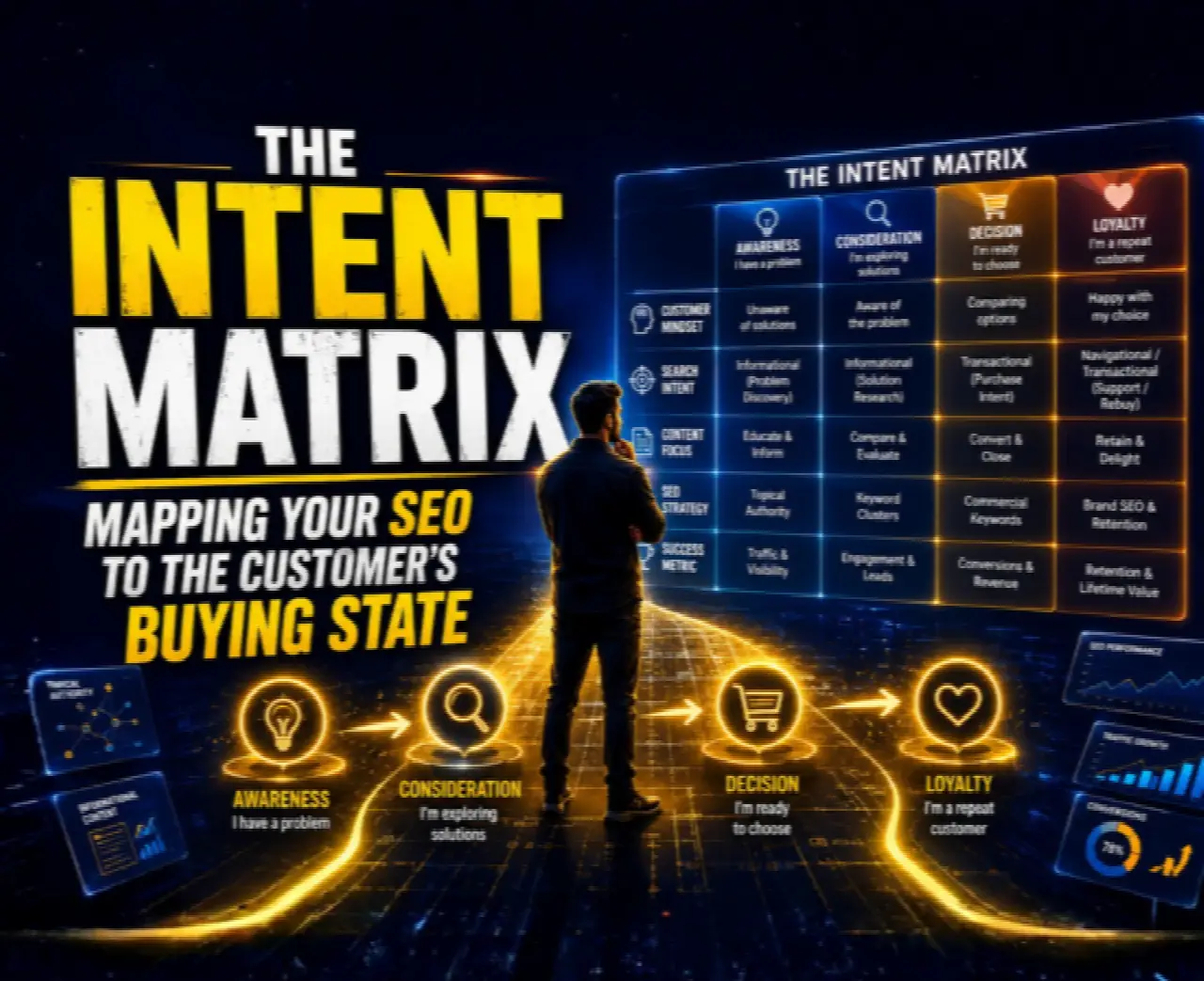
Intent Matrix can help you connect the dots between these mindsets and your SEO efforts. Rather than approaching SEO from the perspective of equal treatment of traffic regardless of its intent, you can prioritize content creation according to your audience's position along the customer journey funnel. At the awareness level, education is key. This is when customers formulate questions and seek to learn the ins and outs of things.
At the consideration level, comparison prevails as users search for in-depth information to assist them in choosing one product over another. At the final stage of intent, customers will be ready to take the next step, which is the actual purchase. This is where you will provide concise yet effective messages that establish trust and elicit action in customers, rather than give long explanations about products and services you have for sale
Why Most Websites Get This Wrong
There are many examples where companies unknowingly misalign their content with user intent. The first one involves attempting to push their offer too soon. When a user is searching for something general, he/she ends up on a landing page that tries to sell him/her a service. Such friction usually ends in an exit right away.
The second example includes overeducating consumers who are already interested in purchasing something. In this scenario, a user searches for prices or services and gets into a lengthy blog post without actually finding anything he/she was looking for. Then there is also a disconnection between the pages. Blogs function independently, service pages do not have enough supporting content, and the users must navigate the process by themselves.
A Simple Way to Identify Intent
You don’t need complex tools to understand intent. In most cases, the answer is already in front of you. Start by searching your target keyword on Google and look at the results:
Are they mostly blogs and guides? The intent is informational.
Do you see comparison articles or “best of” lists? The intent is commercial.
Are the results dominated by service pages or product listings? The intent is transactional.
Search engines are already telling you what users expect. Your job is to align with that expectation. You can also look at the wording of the keyword, like how, what, best, price, and every word tells you a different search intent.
Creating Content That Matches Intent
By the end of the purchase stage, repeat consumers expect to be able to engage with you. Provide a method for people to learn about complicated things and answer their questions, but do not inundate them with information. Help people understand complex things and answer their questions, but don’t overwhelm them.
If someone has commercial intent, go into more depth. Compare different things, explain their differences, and address any concerns that they might have. Show your expertise and help users make good decisions.
In case someone had transactional intent, remove any obstacles for them to describe your offer and explain the benefits of using your product or service. Use testimonials and provide clear direction for the consumer to make a purchasing decision. If a user has navigational intent, ensure your branding is well presented.
Connecting Content Across the Journey
Another way to apply the Intent Matrix is by linking your content. Rather than looking at each page independently, look at your website as a trip. Don’t let a blog post end there; it should lead somewhere. After reading an informative article, show them related content or point them towards your services in a subtle manner.
After reading a comparison article, they should feel confident and led towards your product/service. A service page should not stand alone. You can help them learn more about the service and get rid of their concerns by providing useful resources. It makes the whole process easy for them, as they don’t have to go back searching for something else—they just keep moving forward within your website.
The Timing Advantage
SEO is not merely about appearing in searches. It is about appearing at the right time.
Appearing too soon means they are not ready for conversion yet. Appearing too late means they already have an answer. The Intent Matrix allows you to place your content throughout the entire journey so you do not miss a beat. Rather than using one page to serve all purposes, you can set up a system that caters to the different needs of users.
Measuring Success the Right Way
When you start focusing on intent, your success metrics evolve as well. Instead of only tracking traffic, you begin to look at:
Engagement and time spent on the page
Movement between pages
Conversion rates
Lead quality
You may even notice that some lower-traffic pages generate more business than high-traffic ones. That’s because they attract users with stronger intent. This shift in perspective is what separates average SEO strategies from high-performing ones.
Final Thoughts
Search behavior has shifted, and therefore SEO must shift with it. Gone are the days when ranking for keywords would suffice. In order to truly benefit from SEO, you need to know who is performing the search. The Intent Matrix provides a guide for doing just that.
With it, your results improve in every aspect of SEO. You will drive relevant traffic. You will produce relevant content. You will build a system out of your website.
Written by
Simer Ghuman
Webcooks Team
Keep reading