
Common technical SEO mistakes to avoid
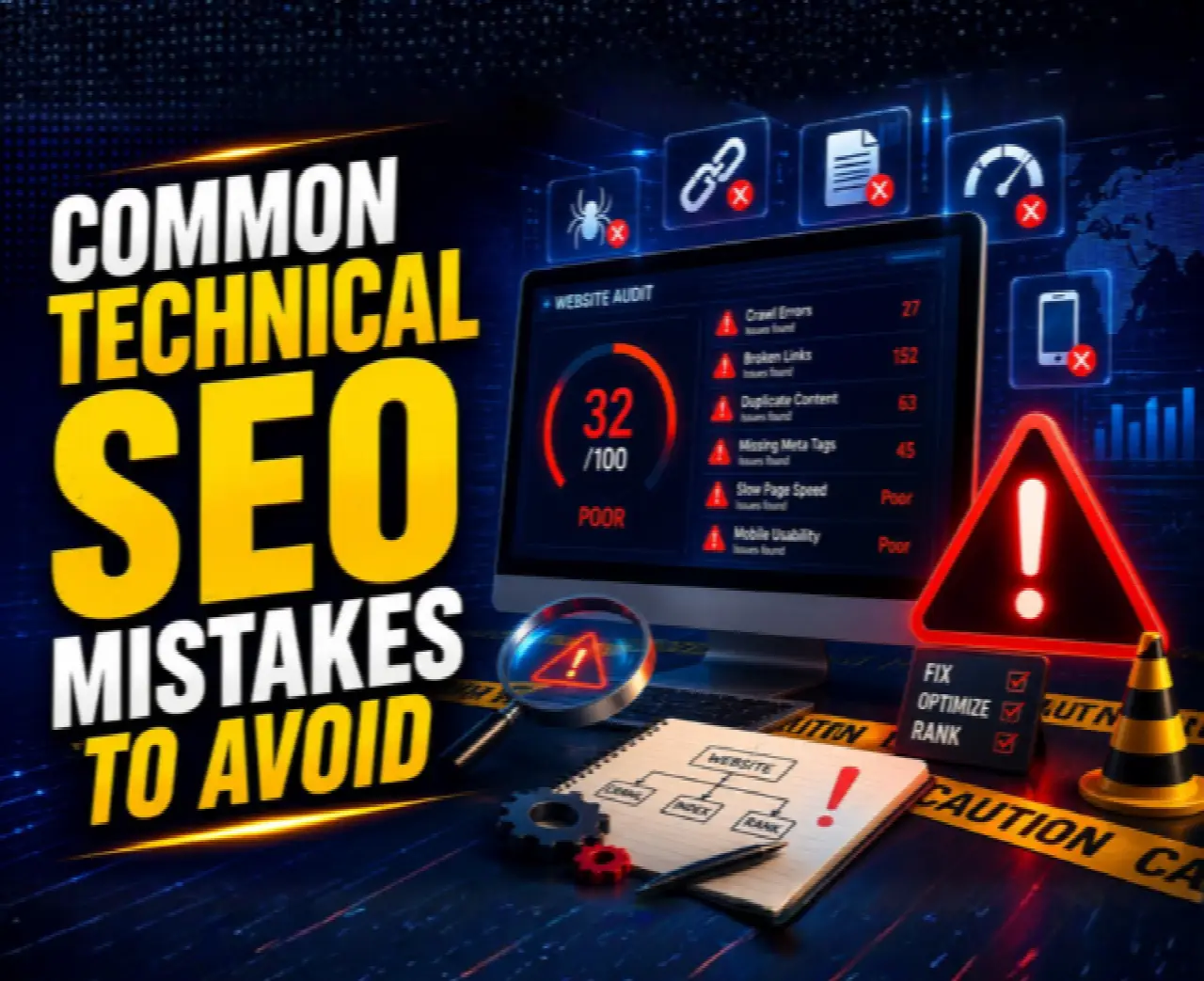
Key Element of Successful Technical SEO is the Backbone of Every Website You have all of the Right Content, Positive Visual Cues and Most Important Products or Services ,but if Your Site Cannot be Found, Indexed, and Understood, Your Digital Presence Will Fall Short of Expectations. Technical SEO can Provide a Database for Search Engines to Access From Your Site, Make a Good First Impression, Provide Relevant Links to Users and Build Greater Trust From Search Engines.
When developing their website’s content strategy, many companies fail to account for technical considerations as well as how they can enable their own content creation. Issues such as broken links, duplicate content, slow load times, inaccurate indexing or incorrect site structures can negatively impact your search visibility without providing you with an explicit indication that something is wrong. Consequently, this will result in decreased search engine rankings, decreased traffic from organic sources and/or fewer satisfied users visiting your website.
Fortunately, Most Technical SEO Errors are Correctable. Regular Site Auditing, Ongoing Maintenance, and Compliance with Google’s Best Practice Guidelines Can Keep Your Site Competitive and Healthy. Understanding the Basics of Technical SEO Allows You to Identify How Technical Issues Will Affect Your Ranking in Search Engines Before They Have an Effect on Your Rankings.
Crawlability and Indexing Issues That Prevent Search Visibility
Indexed pages are very important because once your site’s indexed pages are crawled by search engines, only then can they rank based on relevancy. Without an index, your pages will not be displayed in results regardless of how good your content is.Accidentally using the robots.txt file to block pages is one of the most common mistakes. Robots.txt is very helpful in preventing search engines from crawling pages you don’t want crawled, but can block valuable content from being indexed.
Another issue is using the noindex meta tag incorrectly. Using a noindex tag will ensure Google does not display that page in the results, which many developers do not realize when they leave them left over on their pages after finishing development or redesigning.
An outdated or incomplete XML sitemap is also a common occurrence. Your sitemap should only contain the important, indexable pages of your website, and should be kept up-to-date whenever new pages are added or old pages are removed. By submitting your XML sitemap via Google Search Console, you will aid search engines’ discovery efforts of your content.
A less obvious issue are orphaned pages. These pages exist in your website, but have no other internal (within your site) links to them. Since search engines typically find pages in a website through links to them, orphaned pages.
Website Performance and Core Web Vitals Problems
When it comes to creating a great user experience, speed is no longer one of the only factors that matter; it's now an equally as important part of your overall SEO. Visitors expect fast loading times, while search engines tend to refocus priority towards fast and responsive experiences.Core Web Vitals (Google) help determine page performance by measuring three critical aspects about how well something represents a positive user experience:
• The Largest Contentful Paint (LCP) metric determines how quickly the page's main content is uploaded on the user's device.
• Interaction to Next Paint (INP) evaluates how responsive a web page is to user interactions.
• Cumulative Layout Shift (CLS) assesses the stability of a visual layout by measuring any random differences in the position of items in the visual layout of a web page.
The slow-loading website is primarily caused by having large images, an excessive number of JavaScripts, unoptimized CSS, inferior quality of web hosting and excessive use of third-party scripts. The increased load time results in lower user engagement.Large image files are usually the result of using outdated image formats or not properly utilizing compression techniques. A variety of solutions for these issues exist, including compressing files based on the largest image on your site, utilizing more recent image formats (such as WebP), and implementing lazy loading to enhance the performance of your website while maintaining proper image quality.
Poor Site Architecture and Internal Linking Errors
An organized website structure allows users and search engine spiders to easily navigate through the site's content and locate the information they want. Unfortunately, the issue of poorly constructed site architecture is generally underestimated as one of the predominant Technical Search Engine Optimization (SEO) Problems.Properly written internal linking of web pages creates a framework through which authority (link power) can be distributed throughout the site. When pages are properly linked, search engines understand the types of PageRank or link authority associated with the pages and how they relate to one another; therefore, users can navigate from page to page with relative ease to find similar web page content.Broken internal links cause usability issues for visitors and utilize crawl resources in an inefficient manner. Conducting periodic checks for broken links will help keep users properly directed to functioning web pages.
Another frequent technical SEO issue is inconsistent URL structures. URL structure should be kept clean, short, and descriptive to allow for ease of navigation for both search engines and users. Long URLs with excessive unnecessary parameters are not user-friendly and complicate the web browsing experience with the use of random numbers.URL navigational menus also must be extremely simple in design. The site should define a category navigation menu based on similar scopes of related or adjacent content, therefore simplifying the usability of the site, as well as optimizing the site for crawl efficiency by search engines.
By including breadcrumb navigation as a part of a well-designed website, website users and search engine spiders obtain a clearer understanding of page location/hierarchy within the website.
Duplicate Content, Canonical Tags, and URL Management Mistakes
Most all types of websites, regardless of size, have one common technical SEO problem – duplicate content. Duplicate pages on a site can confuse search engines when trying to determine what page should be displayed in the search results.
Below are some examples where duplicate content can occur.
HTTP and HTTPS versions;
WWW vs Non-WWW versions;
URL parameters;
Printer-friendly URL pages;
Product filter and sort options;
Canonical tags let search engines know which version of a page is to be considered the preferred version or main version. Using the incorrect canonical tag can create problems for indexing and/or increase the difficulty of getting your pages indexed by search engines.
The primary version of every important page should have a correctly self-referencing canonical tag. If you are duplicating the content on purpose then the page (that is the duplicate) should have the canonical tag of the real page.
You also need to properly manage your redirects. If you are moving pages to new locations or merging them into another page you should create a permanent 301 redirect. Avoid redirect chains (ie: one redirect to another and so forth before reaching the final destination) as this will slow down crawlers and decrease their efficiency.
Having your URLs be the same across your website will help to avoid duplicate indexing problems. You need to decide if you are going to use HTTPS on your website or not. Additionally, you need to decide if you will have "www" or not, and make sure that all other options redirect correctly to the preferred one.Any Page can have multiple URLs leading to it, due to the plethora of different ways these pages have been created, making your content less unique. Keeping URLs clean and descriptive.
Mobile Optimization, Security, and Structured Data Errors
Presently, mobile devices account for most online search activity. The mobile version of your site serves as the "main" version of your site, and thus is used in ranking with Google's mobile-first indexing.
When sites do not provide responsive experiences, they're often unable to achieve decent rankings or have sufficient user engagement. Text should be readable without a zoom; buttons should be easy to tap; and layouts should automatically adjust based on the size of users' screens.Security is also an important technical ranking factor. All sites should utilize HTTPS encryption through a valid SSL certificate. When secure pages display insecure resources, browsers create mixed content warnings and reduce users' trust.
By utilizing structured data correctly, your website can also gain significant advantages, some of which include being able to gain new, valuable opportunities that can be earned through search engines via rich results such as answer boxes, reviews on products, and other pieces of information about your products/ services. However, search engines will not be able to accurately interpret the schema markup on a web page if it has been either incorrectly marked, or is not completely filled out. Therefore, it is important to regularly test structured data to check for validation errors so that the information is usable to search engines.
The ongoing nature of technical search-engine-optimization means that it supports virtually all aspects of your overall digital marketing strategy; therefore, the importance of technical SEO cannot be overstated! Thus, if your website is designed for search engines to easily crawl your site, loads fast, has a logical structure (no duplicate content), and provides an excellent experience for the end user by being secure and mobile-friendly, then you will likely achieve higher rankings in the search results pages.By investing in technical SEO today, you will be establishing a strong base for the future success of your online business. Furthermore, you will have the ability to have an always-available website, a competitive website, and the ability to be adaptable to any future modifications imposed by search engines.
Written by
Krishna Sharma
Webcooks Team
Keep reading
Related Posts

Why Google and AI Engines Don't Trust Your Content — E-E-A-T, Authors & Backlinks in 2026
Why Your Content Ranks on Google but Doesn't Appear in AI Answers — GEO & Retrieval SEO Explained