
The Anatomy of Ai Slop: Why Volume-First Marketing is Failing
The Anatomy of Ai Slop: Why Volume-First Marketing is Failing
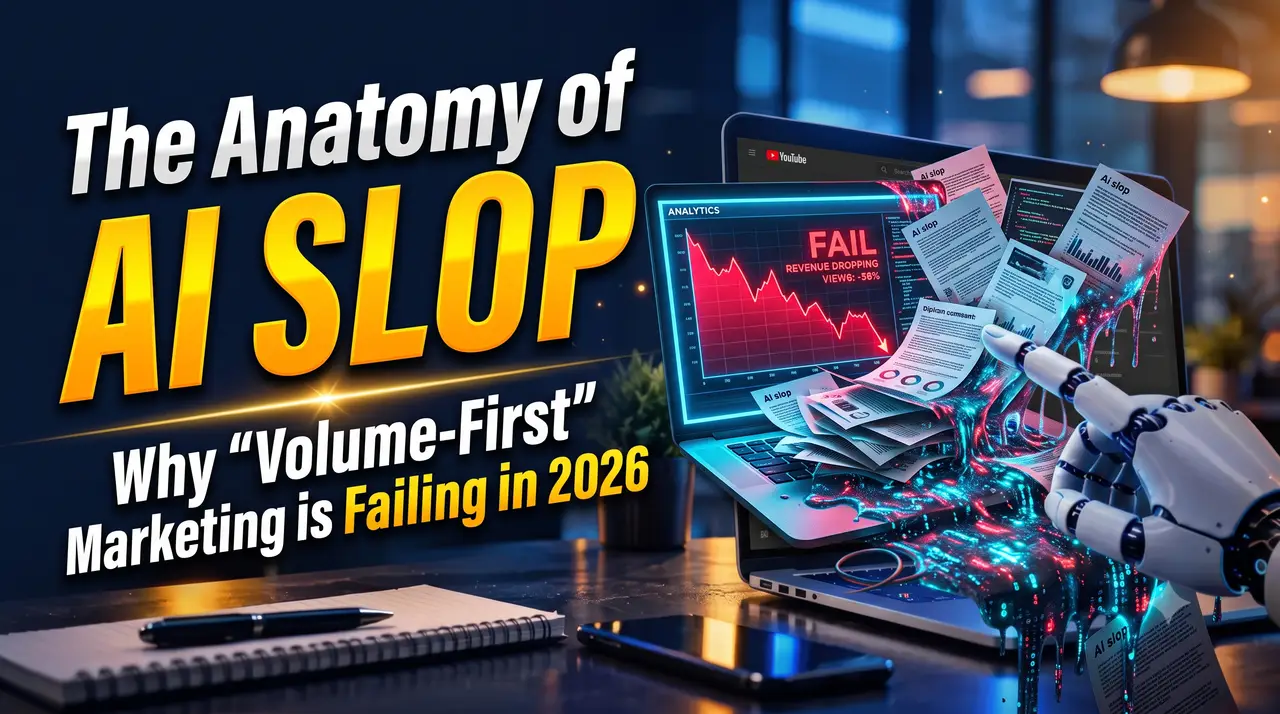
AI has made life much easier for content creators and digital marketers. It also pushed many of them to post more, on every platform, all the time, because they believed that sheer quantity would win the audience's attention. What we got instead was a flood of generic, forgettable content, now commonly called AI slop.
This article looks at what makes content feel like slop, why audiences are tired of it, and why they lose trust in the brands that publish it. It also explains why the old "more is better" approach is starting to backfire. The point is simple: a few thoughtful pieces built on real experience now beat a pile of empty ones.
What is AI slop, and why is it everywhere?
Think about the last five Instagram posts or reels you scrolled past. Most people can't remember what even one of them was about. We move on to the next video within seconds, sometimes without figuring out what the first one was trying to say. Chances are, a good share of that content was AI slop.
So what exactly is it? AI slop is content made with generative AI that lacks real effort, quality or meaning, but gets mass-produced anyway to grab attention. It isn't "bad" the way a typo or a blurry photo is bad. On the surface it's smooth, polished and technically fine, but underneath it's empty. That gap between how competent it looks and how little it actually offers is what makes it slop.
You've probably spotted it before, even if you never had a name for it. It usually looks like this:
Instagram captions that all follow the same script: "I used to think X, but then Y happened, and it changed everything."
Blog articles that stretch a three-sentence idea into 1,500 words just to look thorough.
Product images or thumbnails that seem copied from the same template, with no personality behind them.
Captions and comments so upbeat and agreeable that nothing about them feels like a real person wrote it.
Strip away the polish, and slop usually comes down to four things:
No new idea. It only repackages what has already been said elsewhere.
No personal experience. It reads like a textbook, not like someone who has actually done the thing.
No real point of view. Everything is agreeable, safe and forgettable.
No reason to exist. It was made to fill a content calendar, not because it had something worth saying.
There are simple reasons why there's so much of it right now:
Creating content used to take real time. A solid blog post could take a full day, and a batch of social posts could take a week.
AI cut that down to minutes, so producing more content stopped being expensive.
Once output became cheap, many marketing teams changed their strategy: post daily, post on every platform, flood every channel.
The bet was simple: quantity alone would win attention.
The "Dead Internet" theory and why readers stopped trusting what they see
There's a theory going around called the "Dead Internet" theory. It suggests that most of what we see online no longer comes from real people, and that bots and AI are mostly talking to other bots and AI.
You don't have to believe it fully to feel its effect:
You read a glowing review and instinctively wonder if it's even real.
You see a comment section full of oddly similar praise and assume half of it is fake.
You scroll past a post that sounds "too polished" and skip it without knowing exactly why.
That quiet doubt has changed the way people think online, and it affects how everyone looks at everything, including your content:
They're not reading with an open mind anymore. They're reading with a filter on.
They're actively looking for signs that something isn't human: generic phrasing, a suspiciously upbeat tone, an answer that says a lot without saying anything.
The moment they spot one, they don't just leave that post. They start trusting the brand's voice less from then on.
The real cost of publishing slop
Superficial competence and what it does to brand trust:
AI slop is often grammatically perfect and neatly structured. On paper, it reads fine. But there's a real gap between two things:
Content that reads fine.
Content that actually says something.
That gap is dangerous. Polished but empty content can be worse than content that is plainly bad, because it looks like effort was made when it wasn't. Readers can tell. Even when the words are smooth, they sense the meaning is hollow.
Why AI slop fails Google's E-E-A-T test:
Google judges content quality using a framework called E-E-A-T:
Experience
Expertise
Authoritativeness
Trust
Underneath all four sits one simple question: did a real expert with real experience write this? This is exactly where AI-only content falls apart, right at the first letter:
AI can explain a topic well in theory.
It can't tell you what it was actually like to run an ad campaign that failed.
It can't tell you how a broken product launch was actually fixed.
It can't recreate the moment of talking a nervous client off a ledge at 11 pm.
That lived detail is what both Google and real readers are looking for. Slop gives you the textbook answer, but it never gives you the scar.
Case study: Microsoft:
In August 2023, Microsoft's travel section on MSN published an Ottawa guide that looked like it had been written by a machine. It listed the Ottawa Food Bank as the number three "must-see" spot for travelers and even advised visitors to go on an empty stomach. That line seemed to have been lifted from the food bank's own appeal for help, and it made no sense in the context of a tourist guide. Microsoft took the article down and said it was looking into how it had passed their checks. The writing was fluent and sounded confident, but nobody who actually knew Ottawa had read it. That is exactly the kind of mistake E-E-A-T is meant to catch.
Where the volume-first strategy breaks down
Brand drift: when AI quietly loses your voice:
There's also a slower, quieter problem that people have started calling brand drift. Give AI a topic without strong guardrails, and here's what tends to happen:
It writes something reasonable enough on its own.
But it won't sound like you. Your tone slowly gets replaced by generic AI-speak.
Do that across fifty different pieces of content, and the brand's actual voice slowly dissolves.
Somewhere in that pile, "you" disappeared.
The tricky part is how easy this is to miss:
Each individual post looks fine on its own.
It's only when you zoom out and read ten of them back to back that the problem shows up.
There's no personality holding any of it together. It could have been written by any brand, about any product.
Gizmodo Case study:
In July 2023, G/O Media, the company that owns Gizmodo, published an AI-written article in its io9 section titled "A Chronological List of Star Wars Movies & TV Shows." The only byline was "Gizmodo Bot." The list was not in the correct order, and it left out some shows that fans love. The deputy editor of io9 said he had nothing to do with editing or approving it, and he spoke out about it publicly. The grammar and structure were fine, but the article didn't sound like a publication that readers had trusted for years to know its subject.
The illusion of efficiency in heavy editing:
Many teams have settled on a workflow that seems smart: let AI write the first draft, then edit it heavily. In practice, this often works the other way around:
If the first draft misses the point, the tone or the actual argument, no amount of editing will fix that foundation.
Editing at that stage just means polishing a wrong answer until it looks like a right one.
The time "saved" upfront quietly gets spent later, rewriting instead of writing.
A better instinct flips the order:
Get the direction right before getting the words right.
A rough but correct outline, built from real thinking, beats a smooth but misguided draft every time.
Otherwise, it's the cart before the horse: producing first, thinking later.
Human-centric content: the real SEO differentiator
If everyone has access to the same AI tools, what is left to compete on? The one thing AI can't produce is experience:
Anyone can generate "5 tips for better email marketing."
Almost nobody can tell you what happened the time their own campaign flopped.
Even fewer can explain why it flopped, and what they actually changed because of it.
That story, the specific, lived one, is what makes content impossible to copy.
None of this means facts stop mattering. They still do. But here's the shift:
Correct information used to be the differentiator. Now it's just the price of entry.
What actually separates content that ranks and resonates from content that gets scrolled past is proof that a real person with real experience is standing behind it.
Making the shift: from volume to impact
What should replace "post more, post everywhere"? Maybe a better place to start is asking whether each piece really deserves someone's time.
One well-built article, backed by a real experience or a real opinion, will outperform ten generic ones.
It wins on trust, on search rankings and on how people remember the brand behind it.
That also means thinking about what we track. Instead of looking at how much was published this month, better questions would be:
Did this build trust?
Did this actually sound like us?
Would a real reader stop scrolling for this?
Those questions don't scale as neatly as a content calendar full of AI drafts. That's exactly why they still work.
~Akshit Gupta | Founder: socialamigo.in | Student: webcooks
Written by
Akshit Gupta
Webcooks Team
Keep reading
Related Posts

Why Your YouTube Videos Aren’t Getting Views — YouTube SEO Hacks That Actually Matter in 2026

Why Nobody Watches Your YouTube Videos to the End - A Content Creation Framework That Holds Attention