Why Nobody Watches Your YouTube Videos to the End - A Content Creation Framework That Holds Attention
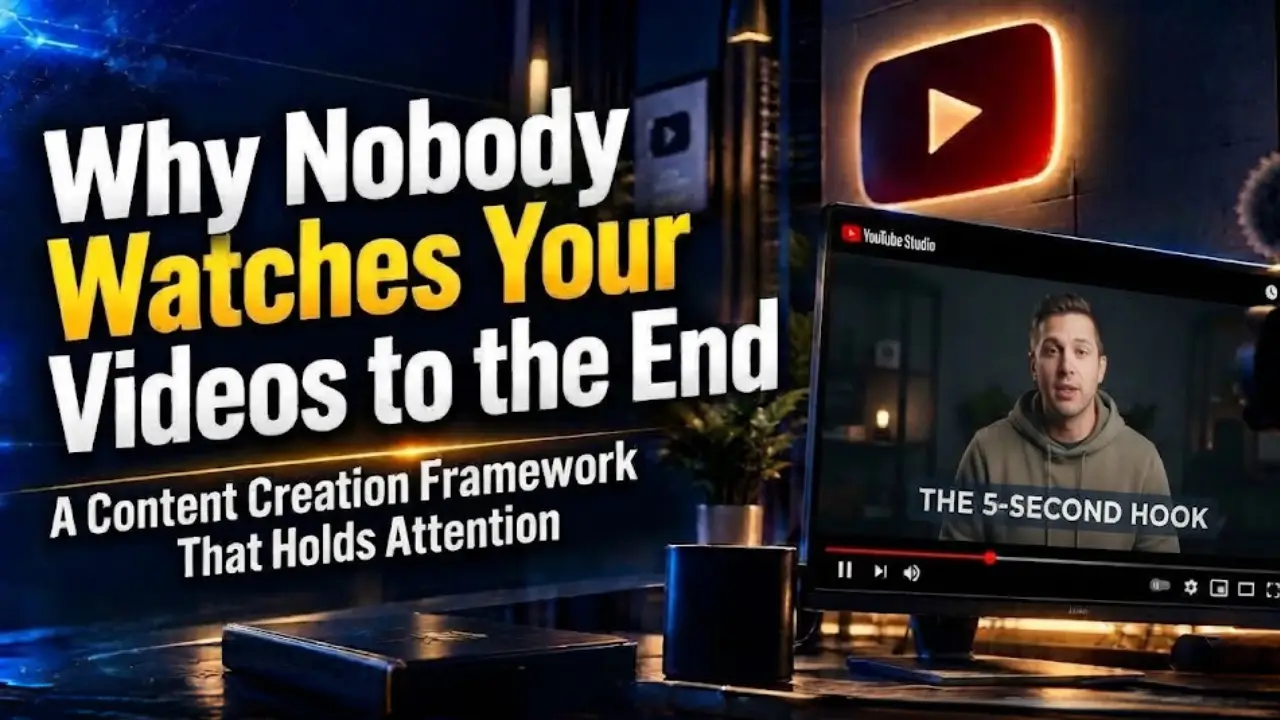
Why Nobody Watches Your YouTube Videos to the End - A Content Creation Framework That Holds Attention
You spend six hours creating a YouTube video.
You research the topic.
Write the script.
Record it.
Edit it.
Design the thumbnail.
Upload it.
Then something frustrating happens.
People actually click the video...
but they leave.
Maybe viewers disappear during the first 30 seconds. Maybe the retention graph gradually collapses. Maybe your 12-minute video gets an average view duration of only three minutes.
At that point, better tags aren't going to rescue you.
Neither is stuffing another keyword into the description.
You have a content problem.
And that brings us to one of the biggest misunderstandings about YouTube:
Giving useful information isn't automatically the same as creating a video people want to watch.
A textbook can contain excellent information.
That doesn't mean someone wants to watch you read it for 15 minutes.
Successful YouTube content has to combine information, curiosity, progression, clarity and payoff.
So before recording your next video, let's answer four questions.
How Do You Find Video Ideas People Actually Want to Watch?
One of the easiest ways to waste time on YouTube is to create a technically excellent video about something your audience barely cares about.
Creators often begin with:
“What should I upload this week?”
Start somewhere else:
“What does my audience already want to know, achieve, avoid or understand?”
That shift sounds small.
It changes your entire content strategy.
Topic ≠ Idea ≠ Angle
Consider an education channel.
Topic: SEO
That's not a video idea.
We can narrow it:
Idea: How to rank a local business.
Better.
Now give it an angle:
“I Tried Ranking a Local Business in 30 Days — Here's What Actually Worked”
Now we have a story.
Same subject.
Completely different potential viewing experience.
Another example:
Topic: Google Ads
Idea: Google Ads mistakes
Angle: “We Audited 20 Google Ads Campaigns — These 7 Mistakes Kept Appearing”
Notice what happened?
We're no longer merely delivering information.
We've created evidence, curiosity and a reason to continue watching.
Start with audience problems
Your best ideas can come from surprisingly ordinary places:
YouTube autocomplete.
Your comments.
Competitor comments.
Customer questions.
Sales conversations.
Google Trends.
Reddit discussions.
Search Console data.
Community posts.
Industry forums.
Support queries.
If you're a digital marketing trainer and students repeatedly ask:
“SEO or Google Ads—which should I learn first?”
that's not merely a question.
That's content demand.
Potential video:
SEO vs Google Ads: Which Skill Should You Learn First in 2026?
Real creator lesson: MrBeast starts with the idea
MrBeast is an extreme entertainment example, so copying his production style makes little sense for most businesses.
But one principle is highly transferable:
the idea itself has to be compelling.
“I spent 24 hours somewhere unusual” already contains a story.
You want to apply the principle—not copy the spectacle.
A B2B version could be:
“I Used Only AI Tools for SEO for 30 Days—Here's What Happened.”
You don't need a million-dollar production budget.
You need an interesting question with a worthwhile answer.
Evergreen vs trend-driven content
Don't choose only one.
Evergreen:
How to Create a Google Ads Search Campaign
Trend-led:
Google Ads AI Max: What Advertisers Need to Know
Evergreen content can continue attracting viewers.
Trend content lets you participate in active conversations.
A healthy channel can use both.
Now ask yourself:
Look at your last ten uploads. How many began with a genuine audience problem—and how many existed mainly because you needed something to upload?
That answer may explain more than your tags ever will.
Why Your First 30 Seconds Decide Whether People Keep Watching
Imagine clicking a video titled:
“7 SEO Changes That Increased Our Traffic 214%”
Then the creator begins:
“Hi guys. Welcome back to our channel. If you're new here, my name is... We've been working in digital marketing for many years. Before we start, please subscribe, hit the notification bell and follow us on Instagram…”
Twenty-five seconds have passed.
And we still haven't discussed SEO.
The viewer clicked because of a promise.
The opening delayed the promise.
Your hook should confirm the click
A better opening might be:
“We changed seven things on this website. Organic traffic increased 214% over the following months—but two changes produced most of the improvement. I'll show you all seven, starting with the one most websites still get wrong.”
Now we've done several things quickly:
Established the outcome.
Created curiosity.
Promised evidence.
Given the viewer a reason to stay.
Don't confuse curiosity with clickbait
Curiosity says:
“Something useful is coming. Keep watching.”
Clickbait says:
“I promised something I can't deliver.”
Huge difference.
Suppose your thumbnail says:
“₹0 → ₹10 LAKH”
and your title says:
“How I Built a ₹10 Lakh Business With YouTube.”
If the video actually documents that journey, the packaging may be aggressive—but the promise is real.
If the video turns into generic advice about posting consistently, the viewer has been misled.
That damages trust.
Open loops work because people want resolution
You can introduce a question early and answer it later.
For example:
“We tested five thumbnail styles. Four behaved roughly as expected. The fifth produced the highest CTR—and it was the design our team originally wanted to reject.”
Now the viewer wants to know which one.
But don't abuse this.
A 10-minute video shouldn't contain nine minutes of artificial suspense for a 20-second answer.
The payoff has to justify the wait.
Real brand lesson: TED
Many successful TED talks demonstrate another form of retention.
They don't necessarily begin with explosions, jump cuts or exaggerated hooks.
Often they begin with a compelling idea, story, question or contradiction.
That's important for business creators.
Retention doesn't require shouting.
It requires relevance.
Your audience should quickly feel:
“This is going somewhere I care about.”
Before publishing your next video, watch only the first 30 seconds.
Then ask:
If I didn't know myself, would I genuinely continue watching this?
Answer as a viewer, not as the person who spent six hours editing it.
How Do You Script YouTube Videos for Retention, Not Just Information?
Many educational videos follow this structure:
Introduction.
Point 1.
Point 2.
Point 3.
Conclusion.
Technically fine.
Emotionally flat.
A more useful framework is:
Hook → Problem → Promise → Evidence → Progression → Payoff → Next Action
Let's build an example.
Video:
“Why Your Google Ads Campaign Is Getting Clicks But No Sales”
Hook
“You've spent ₹25,000 on Google Ads. Traffic is coming in. Nobody is buying. Before you increase the budget, check these four things.”
Problem
Explain why clicks without conversions are dangerous.
Promise
“We'll diagnose the campaign from keyword to landing page so you can identify where the funnel is leaking.”
Evidence
Show an actual campaign, anonymized account, test or realistic dataset.
Progression
Move through the diagnosis:
Search terms.
Keywords.
Ad intent.
Landing page.
Conversion tracking.
Offer.
Payoff
Identify what matters most.
Next action
Show what viewers should change first.
That's a viewing journey.
Use pattern interrupts
A pattern interrupt doesn't have to mean an explosion animation every seven seconds.
It can be:
A screenshot.
A graph.
A camera change.
B-roll.
A question.
On-screen text.
A real example.
A surprising statistic.
A demonstration.
Even silence.
The purpose is to reset attention.
If you've shown the same talking head from the same camera angle for six minutes while explaining a visual concept, you're making the viewer work unnecessarily hard.
Remove what doesn't earn its place
Here's a brutal editing exercise.
Take your finished script and ask about every section:
Does the viewer need this to understand or enjoy what comes next?
If not, cut it.
Creators frequently keep weak sections because:
“But I spent an hour recording that.”
Your viewer doesn't care.
Their decision is simpler:
Continue watching or leave.
Shorts need even tighter storytelling
A Short doesn't give you the luxury of a long setup.
Compare:
“Hello everyone, today I'm going to explain three important mistakes people make when doing SEO…”
with:
“Your website may be ranking on Google and still losing customers. Here's why.”
Immediate problem.
Immediate relevance.
Immediate curiosity.
But remember:
Shorts and long-form are different viewing environments.
Don't assume somebody who watches a 20-second tip automatically wants a 25-minute tutorial.
You still have to build that bridge.
How Do You Build a Repeatable Content System Instead of Chasing Viral Videos?
One video performs 10× better than normal.
What do most creators do?
Celebrate.
Take screenshots.
Tell the team.
Then publish something completely unrelated.
That's a missed opportunity.
The better response is:
Why did this work?
Was it the topic?
Title?
Thumbnail?
Format?
Timing?
Audience?
Search demand?
Story?
Guest?
Trend?
The objective isn't to clone the video.
It's to identify the underlying signal.
Build content pillars
Suppose your channel teaches digital marketing.
You could establish four pillars:
SEO
Paid Advertising
Social Media
AI & Marketing Automation
Now each pillar can contain repeatable series.
SEO:
SEO audits.
SEO experiments.
Technical SEO.
Local SEO.
AI search optimization.
Case studies.
Instead of waking up every Monday thinking:
“What should we upload?”
you now have a content architecture.
One research project can become multiple assets
Suppose you research:
How AI Overviews are changing SEO.
That can become:
1 long-form YouTube video
↓
3 Shorts
↓
1 community poll
↓
1 follow-up Q&A
↓
1 case-study video
↓
1 playlist addition
This isn't mindless repurposing.
Each asset should be adapted to the format.
But your research investment compounds.
Real brand lesson: HubSpot
HubSpot is a useful model for businesses because its broader content ecosystem doesn't depend on one isolated format.
A subject can exist across educational videos, articles, resources, courses and social content.
That's the mindset businesses should borrow.
Don't create isolated posts. Build topic ecosystems.
Build sequels around proven demand
Suppose:
“ChatGPT SEO Tutorial”
gets 40,000 views while your average video gets 4,000.
Possible follow-ups:
ChatGPT Technical SEO
ChatGPT Keyword Research
ChatGPT vs Traditional SEO Tools
I Used ChatGPT for an Entire SEO Audit
7 ChatGPT SEO Mistakes
You're not blindly copying success.
You're following demonstrated audience interest.
Your content system should learn
Every upload gives you information.
Low CTR?
Learn about packaging.
Strong CTR + poor retention?
Learn about expectation mismatch or content quality.
Strong retention + low impressions?
Investigate topic size, audience fit and discovery.
High views + low subscriber conversion?
Ask whether the video attracts the audience you actually want.
YouTube content creation becomes much easier when every video isn't treated as a lottery ticket.
It's an experiment.
And every experiment should make the next one smarter.
So here's the question I want you to answer:
If one of your videos gets 10× your normal views tomorrow, will you simply celebrate—or will you immediately investigate what topic, title, thumbnail and audience made it work?
Because once your content is strong enough to hold attention, another challenge appears.
How do you get the right people to discover it?
That's where YouTube SEO begins.
Not with tags.
Not with keyword stuffing.
With understanding how YouTube discovery actually works.
Written by
Udit
Webcooks Team
Keep reading