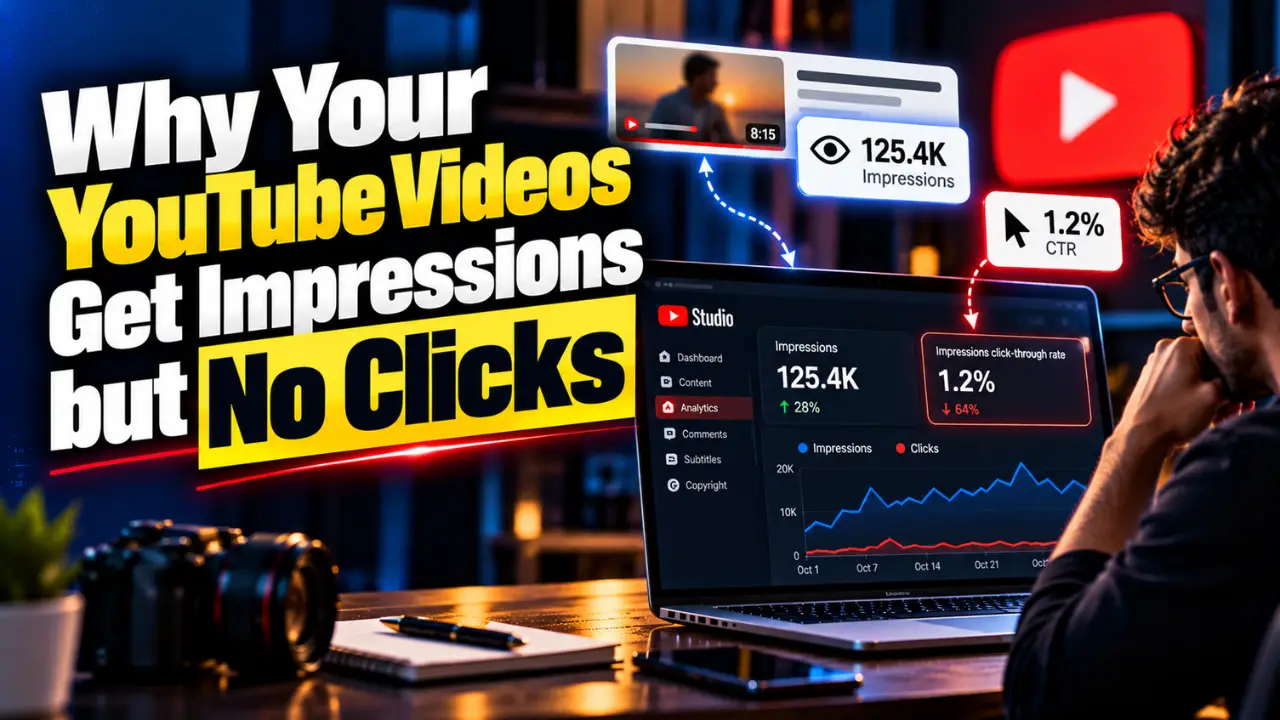
You’ve created an excellent video. The research is solid, the editing is clean and the examples are useful. Retention from the people who watch is actually pretty good.
There’s only one problem: nobody is clicking it.
This is one of the cruel realities of YouTube. Viewers can’t know your video is excellent until they watch it, and they can’t watch it until something convinces them to click. That something is usually a combination of:
Topic + Title + Thumbnail
We call this packaging. Packaging isn’t about tricking people. It’s about communicating enough value and curiosity for the right viewer to say, “That looks worth my time.”
What Actually Makes Someone Click a YouTube Video?
Imagine opening YouTube. You don’t evaluate every thumbnail carefully. You scan. Some videos disappear into the feed, and others make you stop. Why? Often because you instantly understand one of these things:
There’s a problem relevant to me.
There’s an outcome I want.
There’s something I don’t know.
There’s a story I want resolved.
Should Your Title Be Clear or Curious?
Consider “How to Improve Your Website Conversion Rate.” Very clear. Now consider “We Changed One Thing—and Sales Increased 37%.” More curiosity.
Which is better? It depends on the audience and discovery context. A searcher may prefer clarity, while a Home viewer may respond more strongly to curiosity. Strong packaging often balances both.
How Should Your Title and Thumbnail Work Together?
Here is the weak version:
Title: 7 SEO Mistakes That Are Killing Your Rankings
Thumbnail: 7 SEO Mistakes That Are Killing Your Rankings
You’ve said the same thing twice. Now try this:
Title: 7 SEO Mistakes That Are Killing Your Rankings
Thumbnail: #4 COST US 6 MONTHS
Now the thumbnail introduces another reason to investigate.
What Can You Learn From MrBeast’s Thumbnails?
MrBeast is frequently referenced in thumbnail discussions because his packaging is designed around extremely simple, immediately understandable ideas. But here’s where creators go wrong: they copy the facial expressions, arrows, bright objects and huge numbers instead of understanding the underlying principle.
A B2B cybersecurity channel probably shouldn’t look like an extreme entertainment channel. The transferable lesson is to reduce the time required to understand the idea. Your packaging should fit your audience’s expectations.
Is Your Thumbnail Readable on Mobile?
Design a beautiful thumbnail on a 27-inch monitor. Then shrink it. Can you still understand it? Tiny text, six screenshots, four arrows, three logos, two faces, a graph, a circle and “TOP 10 DIGITAL MARKETING STRATEGIES FOR BUSINESS OWNERS 2026.” That’s not a thumbnail. That’s a PowerPoint slide having a crisis. Simplify.
How Do You Research Competitors Without Copying Them?
Competitor research shouldn’t begin with “Which title should we copy?” Begin with “What can audience behaviour teach us?”
Suppose a competing channel usually gets 10,000–20,000 views, then one video gets 350,000. That’s worth investigating. Ask:
What was the topic, and was it timely?
Was the title different?
Was there a strong outcome, or was it a case study?
Was it controversial?
Did it solve a common problem?
Did a larger creator mention it?
Was the thumbnail unusually simple?
Then inspect the comments. What are viewers asking? What confused them? What do they want next?
How Do You Find Outlier Videos?
An outlier is useful because it tells you something behaved differently from normal. Suppose a channel publishes:
“Technical SEO Tutorial” — 12K
“Keyword Research Guide” — 18K
“SEO Content Strategy” — 15K
Then: “I Removed 5,000 Pages From Google — Traffic Increased” — 420K.
Don’t copy the video. Investigate the underlying appeal. Maybe it was a counterintuitive result, a real experiment, a specific number, a high-stakes decision or evidence. Now create your own original version of the principle, such as “We Deleted 63% of a Website’s Blog Posts — Here’s What Happened to Traffic” (only if you’ve actually done the experiment).
Understanding why a topic gets demand is a core search skill, and it’s the foundation of any SEO course in Amritsar.
What Should You Copy From a Competitor, and What Shouldn’t You?
Competitor success tells you something about audience interest. It does not give you permission to reproduce their thumbnail, script, research, examples, branding or story.
Use competitor analysis to discover questions, then answer those questions with your own experience, evidence, perspective, experiments, data and examples. That’s how competitor research creates originality rather than destroying it.
So ask yourself: your competitor gets 300,000 views on a topic. Do you copy their video, or investigate why the audience cared? The second approach builds a channel.
Should You Change Titles and Thumbnails After Publishing?
Your video has been live for three months. It has 120,000 impressions, a 1.8% CTR and strong retention among the people who actually watch. What should you do?
One reasonable hypothesis is that the content may be stronger than its packaging. That’s where a title or thumbnail refresh can make sense. But don’t randomly change packaging every time a video has a slow day.
Why Should You Form a Hypothesis First?
Bad testing: “Let’s try another thumbnail.”
Good testing: “The current thumbnail contains five elements and becomes unreadable on mobile. Let’s test a simpler version focused on the outcome.”
Now you know what you’re testing.
Why Shouldn’t You Change Five Things at Once?
Suppose you change the title, thumbnail, description, opening, chapters and pinned comment. Then performance improves. What did you learn? Almost nothing. Good experimentation isolates meaningful variables where possible.
Can Packaging Attract the Wrong Click?
Imagine Thumbnail A gets a 3.5% CTR and Thumbnail B gets 6.5%. Winner? Maybe. Now suppose viewers from Thumbnail B leave much earlier because it exaggerates the promise. You’ve optimized clicking while damaging viewing.
That’s why CTR is not the objective. A click is the beginning of the experience, not the finish line.
How Should You A/B Test YouTube Thumbnails?
Testing becomes valuable when it answers a real question. Suppose you’re choosing between Thumbnail A (a tool screenshot) and Thumbnail B (a before/after result). Your hypothesis: our audience cares more about the outcome than the interface. Now the test can teach you something useful about future packaging.
Is the Highest CTR Always the Winner?
Don’t just ask which got more clicks. The deeper question is which packaging attracted viewers who actually wanted this content. YouTube’s own testing approach places importance on watch time rather than simply selecting the version with the highest CTR. That’s an important philosophy: a thumbnail’s job isn’t to generate random clicks, it’s to attract appropriate clicks.
How Do You Build a Packaging Library?
Over time, document your experiments. For example:
Case-study thumbnails: before/after numbers perform well.
Tutorial thumbnails: simple interface plus outcome works.
Opinion videos: a strong statement works.
Interviews: guest recognition matters.
Now you’re no longer designing every thumbnail from scratch. You’re building knowledge about your audience.
What Does a Real Thumbnail Experiment Look Like?
Video: “How We Improved an Ecommerce Site’s SEO.”
Thumbnail A: website screenshot + “SEO CASE STUDY”
Thumbnail B: traffic graph + “+184%”
Thumbnail C: before/after graph + “6 MONTHS”
Don’t ask only which looks nicest. Ask which communicates the strongest relevant reason to watch. Then test, learn and apply.
What Is the Packaging Formula?
Think of YouTube performance like this:
Topic earns potential.
Thumbnail and title earn attention.
The opening earns continued attention.
The content earns satisfaction.
The channel earns another view.
You can’t fix a weak topic forever with a thumbnail. You can’t fix a misleading thumbnail with editing. And you can’t build loyalty if the content doesn’t deliver. Everything has to synchronize.
Which brings us to a powerful idea: your audience is constantly telling you what’s working, through impressions, clicks, retention, comments, returning behaviour and traffic sources. You just need to know how to read the signals.
Packaging, testing and reading audience signals are the same skills used across digital marketing training in Amritsar. Learning from outside Amritsar? Explore our online digital marketing courses.
Written by
Udit
Webcooks Team
Keep reading