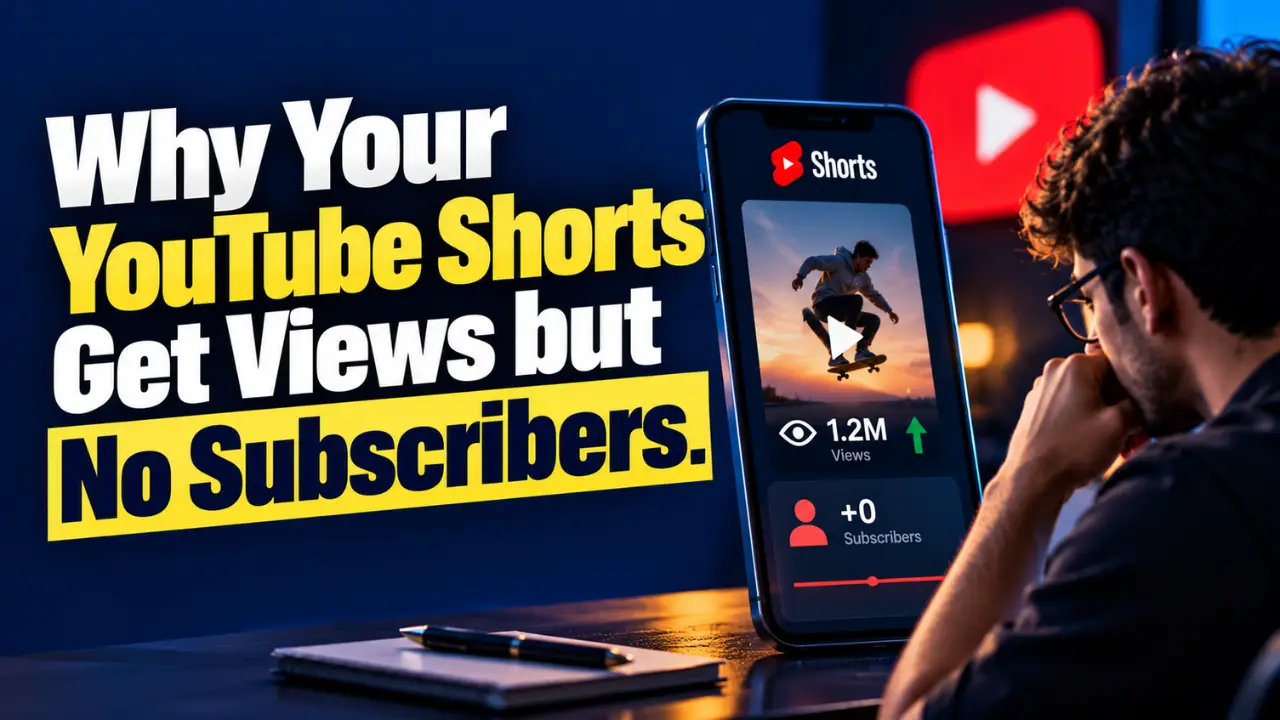
Your YouTube Short gets 500,000 views. Great. Thousands of people watched it, the comments are flowing and subscribers increased.
Then you publish your next 15-minute video. 642 views.
What happened? Didn’t those 500,000 people become your audience? Not necessarily, and this is where creators often confuse reach with relationship.
A person watching a 25-second Short while rapidly scrolling through the Shorts feed is behaving differently from someone intentionally watching your 20-minute tutorial, joining your livestream or returning every week for your podcast. They are all YouTube viewers, but they are not at the same stage of their relationship with you.
That is why a modern YouTube strategy shouldn’t ask only, “How do we get more views?” It should ask, “How do we turn different viewing formats into one connected audience?”
Shorts can create discovery.
Long-form can build depth.
Live streams can create interaction.
Podcasts can build familiarity.
Community posts can maintain relationships between uploads.
Used separately, they’re content formats. Used together, they become an audience ecosystem. Let’s build one.
Why Are Your YouTube Shorts Getting Views but Not Building an Audience?
Shorts can create extraordinary reach. They can also create an illusion. Imagine this result:
Short A: 750,000 views, 12,000 likes, 2,000 new subscribers.
Looks fantastic. Now look deeper. Those new subscribers barely watch your long-form videos, and your next three uploads perform almost exactly as they did before the viral Short. Was the Short successful? It depends on your objective. If the goal was awareness, perhaps yes. If the goal was building a long-form audience, maybe not.
Does Your Short Give People a Reason to Stop Scrolling?
Long-form viewers may give you a little time. Shorts viewers can swipe almost instantly. Compare these two openings:
“Hello everyone, today we’re going to discuss three important SEO mistakes…”
“Your website can rank #1 on Google and still lose customers. Here’s how.”
The second version creates immediate tension. The viewer now has a question: how can ranking #1 still be a problem? That earns another few seconds, and in Shorts, a few seconds matter.
Why Shouldn’t You Simply Shrink Long-Form Videos Into Shorts?
A common repurposing strategy is to take a 20-minute video, find a random 30-second section, add captions and upload it as a Short. Sometimes that works. Often it feels like someone walked into a conversation halfway through.
A Short needs its own structure: Hook → Context → Insight → Payoff. For example, if your long-form topic is “How to Audit a Google Ads Campaign,” your Short could be: “Before increasing your Google Ads budget, check this number.” Show the metric, explain why it matters, give the takeaway, and then, where appropriate, connect it to deeper content.
How Do You Build Content Bridges From Shorts to Long-Form?
Suppose your Short says, “Three reasons your Google Ads clicks aren’t converting.” At the end you add: “Those are three quick checks. In our full campaign audit, we cover the complete conversion path from search term to landing page.”
Now the Short isn’t an isolated piece of content. It’s an entry point. The journey becomes:
Short
Long-form video
Related playlist
Returning viewer
That is far more valuable than Short → Swipe → Gone.
Also remember that someone who likes your 20-second marketing fact may not want your 45-minute marketing podcast, and that’s okay. Your job isn’t to force every viewer through every format. It’s to create logical pathways for the people who want more.
Can You Use Shorts to Test Video Ideas?
Yes. Shorts can become a research environment. Suppose you publish five Shorts: SEO Mistakes, Google Ads Mistakes, Instagram Algorithm Update, AI Marketing Tools and Local SEO Tips. One generates unusually strong viewer response and comments. That’s a signal. Not proof, a signal.
You could now investigate whether that subject deserves a long-form tutorial, a case study, a live Q&A, a podcast discussion or a series. This is how Shorts can feed your larger content strategy.
So here’s your first question: if your next Short gets one million views but none of those viewers watch anything else you create, what exactly did that million views accomplish? There isn’t one correct answer, but you should know yours before chasing viral Shorts.
How Do You Turn Viewers Into a YouTube Community?
Views are transactions. Communities are relationships. A viewer watches. A community member returns, comments, asks questions, recognizes recurring themes and sometimes helps shape what gets created next.
This doesn’t mean every channel needs to become a giant fan club. For businesses and educational channels, community can simply mean an audience that trusts you enough to return.
Is Your Comments Section a Research Department?
Imagine publishing “Complete Technical SEO Audit Tutorial.” Then someone comments, “Can you show how you’d do this for a Shopify website?” Another asks, “What if the site has 100,000 products?” Another: “Can you make a Screaming Frog tutorial?”
You could reply, “Thanks for watching!” Or you could recognize that your audience has just handed you three future content ideas. This is audience synchronization: instead of deciding everything internally and pushing content outward, you let audience response influence what comes next.
What Questions Get People to Comment?
A generic call to action like “Comment below!” leaves people wondering what to comment. A better question is: “Which part of your SEO audit takes you the longest: technical issues, keywords, content or backlinks?” Now people have something concrete to answer, and their answers give you research.
How Can Community Posts Keep Your Audience Engaged Between Uploads?
Your audience relationship doesn’t have to disappear between videos. Community posts can be used for polls, questions, updates, images, follow-up discussions and testing potential topics. For example:
Which video should we create next?
A. GA4 Ecommerce Setup
B. Google Ads Audit
C. Local SEO Case Study
D. AI SEO Workflow
You’re engaging the audience while collecting demand signals.
Why Shouldn’t You Only Broadcast?
The broader lesson from brands that build strong social communities is simple: social platforms aren’t television. If every message is NEW VIDEO, NEW PRODUCT, BUY THIS, WATCH THIS, REGISTER NOW, you’re broadcasting, not interacting. YouTube gives creators comments, Community features and live chat for a reason. Use them. Building this kind of two-way interaction is a core skill in any social media marketing course in Amritsar.
Why Do Returning Viewers Matter More Than One-Time Views?
Imagine two channels. Channel A gets 100,000 viewers from one viral topic, and most never return. Channel B gets 30,000 viewers, and a meaningful portion repeatedly watches related uploads. Which audience would you rather build a business around?
Context matters, but for education, B2B and authority-driven channels, recurring attention can be extremely valuable.
When Should You Use YouTube Live Streams, Premieres and Podcasts?
Not every idea needs to become an edited 12-minute video. Some subjects benefit from conversation, others need demonstration, and others benefit from depth. That’s where live and podcast-style formats become useful.
What Can Live Streams Do That Edited Videos Can’t?
Imagine you’re teaching Google Ads. Instead of another tutorial, you host “LIVE: Auditing Your Google Ads Campaigns.” Viewers submit questions, you analyse examples and people ask follow-ups. The audience watches your reasoning process, not merely the polished conclusion. That can build a different type of trust.
Live formats work particularly well for Q&As, product demonstrations, launches, webinars, interviews, live audits, event coverage, industry updates and training sessions.
Why Shouldn’t You Go Live Just Because the Feature Exists?
A live stream with no premise quickly becomes: “Hi guys… we’re waiting for more people to join…” Five minutes later: “Let’s wait another two minutes…” That isn’t a strategy.
Give the live session a reason to exist. “Bring Your Website — We’re Auditing 10 Homepages Live” is a premise. “We’re Live!” isn’t.
How Can a Podcast Build Depth and Trust?
Podcasts offer something short-form content struggles to provide: extended conversation. A 60-minute discussion with an experienced ecommerce founder can explore mistakes, decisions, failures, numbers, experiments and lessons that don’t fit naturally into a seven-minute tutorial.
One strong podcast conversation can also become multiple assets:
1 full episode
5–10 clips or Shorts
1 highlight compilation
Community questions
Blog insights
Newsletter content
But there’s an important warning: don’t create a podcast because everyone has a podcast. Ask yourself, do we have conversations worth listening to?
Should You Use Guests for Expertise or Decoration?
A recognizable guest may attract clicks, but the conversation still needs substance. For a digital marketing channel, a smaller practitioner who has managed ₹10 crore in advertising spend may produce a more valuable conversation than a larger lifestyle creator with no connection to the subject. Audience relevance matters. Again.
How Do You Connect Every YouTube Format Into One Content Ecosystem?
This is where everything comes together. Imagine you’re building a channel around digital marketing, the kind of practical topics taught in a digital marketing course in Amritsar. Your monthly theme is Google Ads optimization, a skill covered hands-on in a Google Ads course in Amritsar.
Instead of creating unrelated content, build an ecosystem:
Discovery (Short): “The Google Ads Metric Beginners Keep Ignoring.” Purpose: get attention.
Education (Long-form): “How to Audit a Google Ads Campaign Step by Step.” Purpose: build expertise and solve the larger problem.
Interaction (Community poll): “What’s your biggest Google Ads problem?” Purpose: gather audience feedback.
Depth (Live session): “Google Ads Campaign Audits — Live.” Purpose: demonstrate expertise and interact.
Authority (Podcast or interview): “What We Learned Managing ₹1 Crore+ in Paid Campaigns.” Purpose: explore deeper experience.
Conversion (Case study, service or course video): Purpose: show how the expertise becomes an outcome.
Now you’re no longer posting five pieces of content. You’re telling one connected story through five formats.
What Does This Look Like for a Real Business?
Imagine a software company launching a new AI analytics product. It could publish:
Short: “Your analytics dashboard may be hiding this problem.”
Tutorial: “How to Find Revenue Leaks Using Customer Data.”
Live: product walkthrough and Q&A.
Founder podcast: why the product was built.
Community poll: which analytics problem should we solve next?
Case study: how Customer X improved conversion.
That’s audience synchronization. Every format feeds another, every audience response can influence the next piece, and every piece has a specific role.
Which YouTube Format Is Best?
Are Shorts better than long-form? Are podcasts better? Should you livestream? Wrong question. Ask instead: what job does this format need to perform? A useful framework is:
Shorts = discovery
Long-form = education
Live and podcast = depth and trust
Community = relationship
Business content = conversion
Not every channel needs every format. But if you use multiple formats, make them work together. Getting attention is becoming easier. Keeping attention connected to your brand is much harder.
And once someone does discover you, another battle begins. They see your video among ten alternatives. Your idea and your content might be excellent, but none of that matters if they don’t click. Which brings us to one of the most underestimated skills on YouTube: packaging.
Written by
Udit
Webcooks Team
Keep reading