How to Read YouTube Analytics: Turn Views, CTR and Retention Into Your Next Video
How to Read YouTube Analytics: Turn Views, CTR and Retention Into Your Next Video
YouTube Analytics can become addictive.
Views up? Happy.
Views down? Panic.
Subscriber gained? Great.
Subscriber lost? What happened?!
But analytics isn't supposed to be a daily emotional scoreboard. It's supposed to be a decision-making system.
The most useful question isn't: "How many views did we get?"
It's: "What did viewer behaviour teach us that should change what we do next?"
That's the difference between reporting and analysis. Let's turn YouTube Analytics into a content strategy.
6 YouTube Analytics Situations and What Each One Means
Consider six different situations.
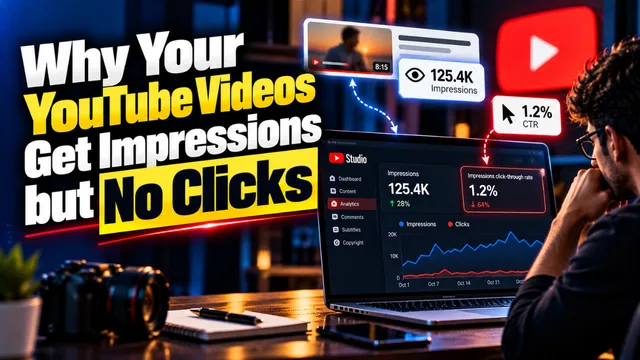
High impressions but low CTR
YouTube is showing the video. People aren't choosing it.
Investigate:
Topic appeal.
Thumbnail.
Title.
Audience match.
Competitive context.
Don't immediately conclude: "The algorithm isn't giving us reach." You already have impressions. Your first problem may be converting them into views.
High CTR but poor early retention
People click. Then leave.
Possible explanation: packaging promise ≠ viewing experience.
Maybe your thumbnail promises "WE INCREASED SALES 300%" but you spend the first four minutes explaining what your agency does. The viewer didn't click for your company history. They clicked for the case study.
Low CTR but excellent retention
Interesting. The people who do watch appear to like the video. That may indicate an opportunity to investigate packaging or audience targeting. Perhaps the content is strong but presented weakly.
That's exactly the kind of video you might consider for a packaging experiment.
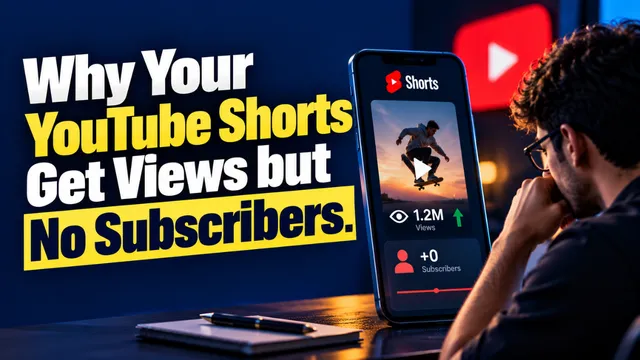
High views but few new subscribers
Is that bad? Not automatically.
Maybe the video answers a one-time question. For example: "How to Delete Your Instagram Account." Someone solves the problem. Leaves. Never needs you again. That's normal.
But if every video behaves this way, ask whether you're building a coherent audience or merely collecting unrelated search traffic.
Subscribers rising but few returning viewers
Again, investigate. Why did people subscribe? Are your subsequent videos about the same thing they subscribed for?
Suppose someone subscribes after "Complete Canva Tutorial." Then your next videos are:
Office vlog.
SEO.
What exactly should that subscriber return for?
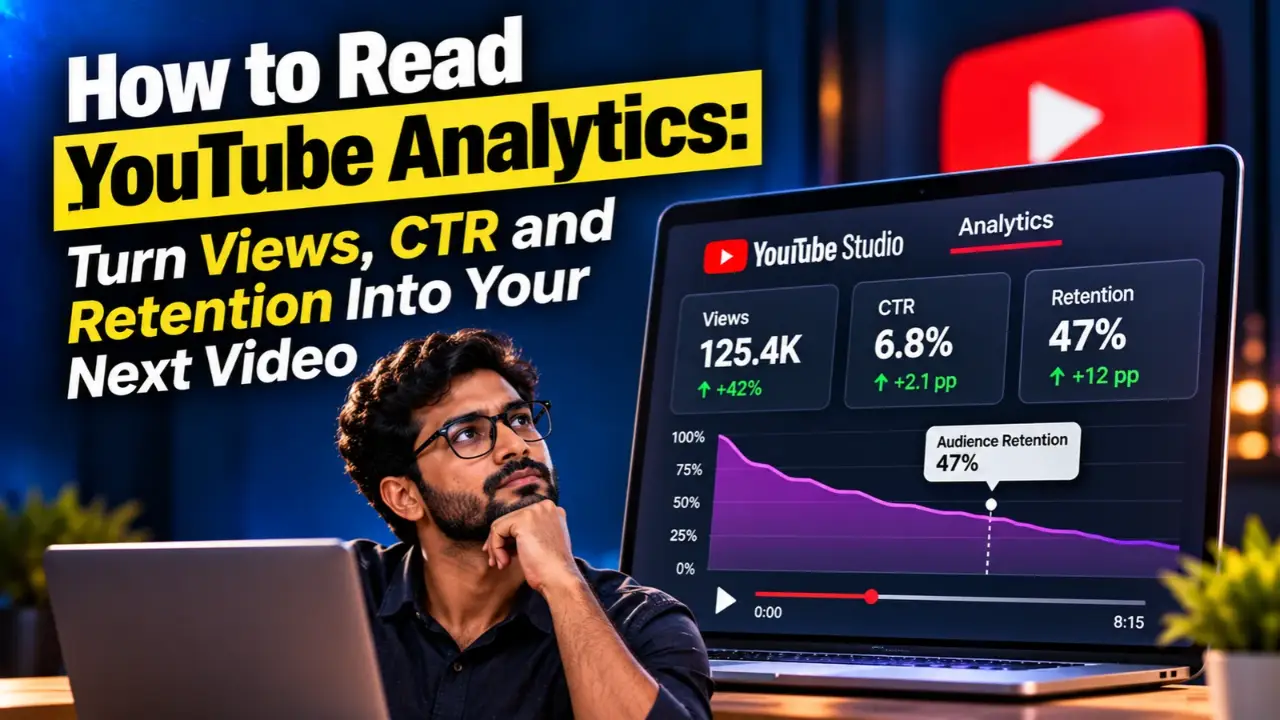
A spike in the audience retention graph
This one is fascinating. People replayed or revisited a particular section. What happened there?
Maybe you:
Showed a template.
Demonstrated a technique.
Shared a number.
Explained something visually.
Revealed the result.
That spike might contain your next video. If thousands of people repeatedly watch the 40-second section where you explain schema markup, perhaps "Complete Schema Markup Tutorial" deserves consideration.
Your analytics isn't just measuring old content. It's helping research new content.
How to Build a YouTube Content Calendar From Your Analytics
Most content calendars begin with dates.
Monday: Short.
Wednesday: Tutorial.
Friday: Reel.
That's scheduling. Not strategy. A better content calendar begins with evidence.
Proven topic: build on what already works
Your "Local SEO Guide" video performs 4× above average. Potential follow-ups:
Google Business Profile Audit
Local SEO Mistakes
Local SEO Case Study
How to Get More Google Reviews
Audience question: answer it with a video
Multiple viewers ask: "Does this work for Shopify?"
Potential video: Technical SEO for Shopify: Complete Audit
Retention spike: turn a moment into a full video
Viewers repeatedly watch your section on internal linking.
Potential video: Internal Linking Strategy: Complete Tutorial
Search opportunity: make evergreen content
People are actively searching for a relevant problem. Create evergreen content.
Industry change: make timely content
YouTube, Google, Meta or another platform launches something important. Create timely content.
Now your calendar is driven by:
Audience demand + performance evidence + business relevance + market changes
rather than: "We need three uploads this week."
Content buckets that keep your channel balanced
A healthy calendar can include:
Evergreen education
Experiments/case studies
Timely industry topics
Audience-requested content
Commercial/trust content
This prevents the channel from becoming dependent on one discovery mechanism.
A simple analytics feedback loop
Your workflow should become:
Publish
Collect data
Interpret
Form hypothesis
Create/test
Measure
Repeat
That's audience synchronization at the operational level. The audience isn't dictating your strategy. But their behaviour is informing it.
How to Choose YouTube Creators to Collaborate With
Suppose you run an SEO software company. You have two potential collaborators.
Creator A: 500,000 subscribers. General entrepreneurship/lifestyle audience.
Creator B: 45,000 subscribers. SEO specialists, agency owners and in-house marketers.
Who should you choose? Subscriber count alone says A. Audience relevance may say B.
Why a collaboration is an audience exchange
A good collaboration introduces your expertise to their audience and their expertise to yours. The overlap needs to make sense.
Potential formats:
Expert interviews.
Joint experiments.
Debates.
Audits.
Challenges.
Guest tutorials.
Case studies.
Roundtables.
Live sessions.
Podcast conversations.
A brand lesson from influencer marketing
Brands sometimes make the same mistake with influencer marketing. They buy the biggest audience they can afford. Then wonder why conversion is poor.
Reach without relevance is expensive noise. A smaller creator with strong authority inside a niche can sometimes produce significantly more meaningful business outcomes.
Give every collaboration a clear premise
Weak: "Podcast With John Smith"
Better: "We Asked a Google Ads Expert to Audit 5 Losing Campaigns"
The second version gives people a reason to care even if they don't know John. The guest supports the idea. The guest isn't the entire idea.
How to Run YouTube Growth Experiments That Teach You Something
Creators often test constantly without realizing it. New thumbnail. Different upload time. Longer video. Shorter intro. Different title. New format.
But if you change everything at once, you don't know what produced the result. Build an experiment system.
Step 1: Find the problem
Example: strong impressions, weak CTR.
Step 2: Form a hypothesis
"Our thumbnails contain too much text and become difficult to understand on mobile."
Step 3: Change something intentionally
Test simpler packaging.
Step 4: Choose relevant measurements
Don't measure only views. Depending on the experiment:
CTR.
Watch time.
Retention.
Returning viewers.
Subscriber conversion.
Leads.
Step 5: Write down the result
Hypothesis: Simpler thumbnails will attract more appropriate clicks.
Change: Reduced text from seven words to two.
Result: Improved viewing response.
Learning: Outcome-led visual performed better for this series.
Next test: Compare outcome number vs problem statement.
Now your channel accumulates knowledge.
A six-month experiment roadmap
Month 1: Packaging
Month 2: First 30 seconds
Month 3: Content series
Month 4: Shorts → long-form conversion
Month 5: End-screen journey
Month 6: Community-driven topics
You don't need to run experiments exactly like this. The principle is what matters: growth should produce learning. Because channels that understand their audience have an enormous advantage over channels that simply upload more.
And now we reach the final layer. You can optimize. Create. Get discovered. Build community. Analyze. Experiment.
But YouTube is increasingly operating inside a world shaped by AI-generated content, copyright complexity, creator sponsorships and paid distribution. So the final question isn't merely: How do we grow a YouTube channel?
It's: How do we build a sustainable YouTube business without losing originality, trust or control?
Written by
Udit
Webcooks Team