Answer Engine Optimization (AEO): How to Rank When LLM is the Search Engine
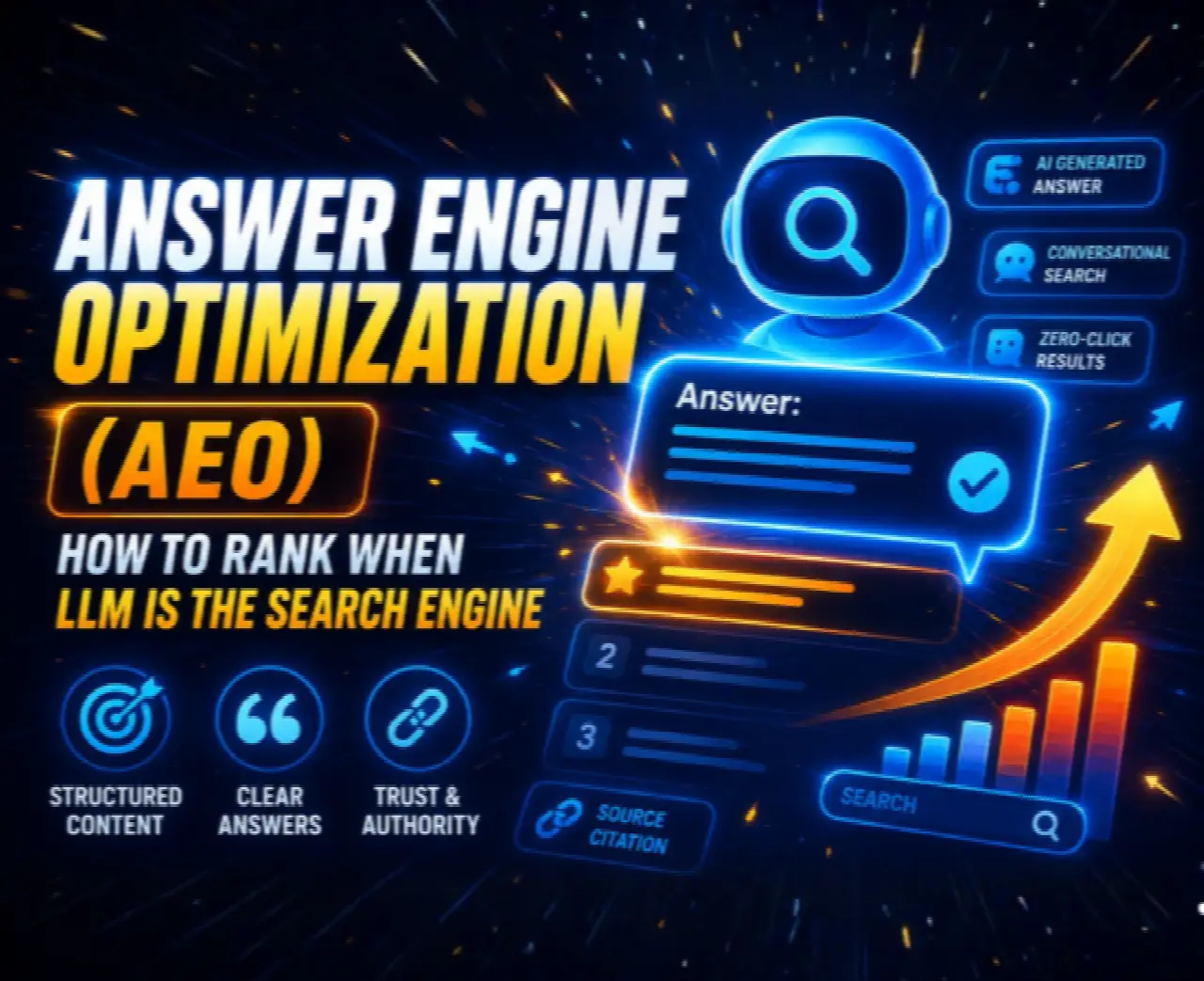
Answer Engine Optimization (AEO): How to Rank When LLM is the Search Engine
Search behavior is evolving faster than ever as the time goes by. Traditional search engines such as Google, Bing, Yahoo Search, DuckDuckGo etc. used to depend mainly on keywords, where users typed short phrases like “best fast food in Amritsar” or “digital marketing course/training in Amritsar.” Search engines scan billions of web pages in the blink of an eye, rank them using algorithms, and display a list of links called SERPs for users to explore and get relevant answers to their respective queries. Today, the introduction of Artificial Intelligence in the digital world has fundamentally changed how people search and consume information online.
Nowadays users interact with AI assistants such as Google Gemini, ChatGPT, Perplexity AI and Microsoft Copilot by asking complete/complex questions in natural language - just like talking to a human expert face-to-face. These systems deliver direct/relevant answers to the questions put forward by the users, not just website links - generating the need for Answer Engine Optimization (AEO).
What is Answer Engine Optimization (AEO)?
AEO is an advanced form of search optimization focused on making your content the direct answer for particular queries from the user end, selected and delivered by AI-powered search systems and virtual assistants. AEO has become a vital part of the digital/performance marketing field.
Unlike traditional SEO, which aims to rank webpages on search engine result pages and getting traffic to websites, AEO focuses on optimizing content for answer engines/platforms such as ChatGPT, Google’s AI Overviews, voice assistants, and conversational search tools that provide instant, summarized responses instead of lists of links or redirecting users to different websites for exact/most relevant answers.
AEO involves structuring information point-wise in a clear, context-rich, and machine-understandable format so that AI systems can easily interpret, trust, and extract your content when responding to users’ questions. This includes using natural/layman’s language, question-based content, semantic relevance, structured data, authoritative sources, and concise explanations that directly satisfy user intent.
In simple terms, AEO ensures your content becomes the exact answer to the user’s queries, not just another search result - increasing visibility in voice search, AI-generated summaries, featured snippets, and conversational search experiences.
Basic Goals of AEO
To get direct/relevant answers to the users’ queries, not just a ranked page.
Fetch meaningful, clear, structured, trustworthy information to the users.
Optimization for AI understanding and user intent for any queries related to any brand or business.
SEO vs AEO - Why Keyword Stuffing No Longer Works
Old SEO depended on repeating keywords in digital content, but modern AI understands meaning.
Shift from SEO - AEO
Keyword repetition - Answer quality
Earlier, content used to be ranked by repeating the same keyword multiple times, like some institute name, eg. Webcooks, but today, search systems prioritize how clearly and accurately a page answers a user’s question. High-quality explanations of queries, useful information as per questions asked, and real value matter more than keyword frequency.Exact matches - Intent understanding
Traditional search relied mainly on exact keyword matches between queries and webpages. Modern search focuses on understanding why the user is searching - their intent, problem, or goal - even if the exact words are different. If somebody is searching something related to brands Rebook or Nike, specifically shoes, AI starts looking for answers based on users intent based on recent search history or other online experience.Robot writing - Human explanations
Content written only for algorithms often sounded mechanical and unnatural, not easy to understand by users. Now, search engines prefer human-friendly language that explains concepts simply, naturally, and conversationally, making information easier to understand without going into mechanical or technical aspects of information.Ranking pages - Selecting answers
Search used to rank many webpages and let users choose which link to open and which to not as per their choice or understanding. Today, AI-driven systems often analyze multiple sources and directly select or summarize the best answer to the queries put forward, reducing the need for users to visit several pages.
How ChatGPT Decides What to Quote
AI tools select content based on quality signals like clear explanations of things or data, direct answers first, structured headings & formatting, topic authority consistency, EEAT (Experience, Expertise, Authority and Trust), Natural language writing and question-based content.
The Direct Answer Format
Provide the answers immediately after the questions put forward by the users. It is a content structure designed to give users a clear, meaningful, relevant immediate answer to a question without requiring them to read an entire article or go through various websites or click links. Instead of forcing users to search through long paragraphs and waste time, the information is presented upfront in a concise and easy-to-understand way. It helps search engines and AI systems quickly identify the most relevant response as per the requirement and intent of the user and display it directly in search results, featured snippets, voice search responses, or AI-generated summaries.
Structure includes Quick answer, Simple explanation and Supporting details.
Benefits consist of Easy for humans to read, Easy for AI to extract and Works for voice search and featured snippets.
Conversational Queries - How People Actually Search
Conversational queries refer to the natural, question-based way people search online today by asking direct questions and being specific about their needs. Instead of typing short keywords, users now search using complete sentences, just like they speak in real conversations between people regarding certain things. This shift has grown rapidly due to voice assistants, mobile searches, and AI chat interfaces in day-to-day life.
Modern users ask things like “Which is the best CCTV camera for home security?” rather than typing “best CCTV camera.” Search systems analyze the full question to understand intent, context, and expected outcomes catering to the users’ needs. Platforms such as Google increasingly prioritize content that sounds natural, answers questions directly, and mirrors real human language.
For marketers and content creators, this means writing in a conversational tone, focusing on user problems, and structuring content around real questions people ask. Optimizing for conversational queries improves visibility in voice search, AI-generated answers, and zero-click search results, making it a key element of modern SEO and AEO strategies.
Information Density — Why Fluff Hurts Rankings
AI values useful information per sentence, not word count. Meaningful information only and no irrelevant stories or explanations.
High-Density Content includes Direct answers, unique insights and Concise explanations.
Fluff Content means Long introductions, Repetition, Generic statements and Keyword stuffing.
Power of Lists, Tables & Bullet Points
AI scans content instead of reading line by line. The more it is in listed form, the more convenient it is for the AI to scan and provide the relevant information to the users.
Use:
Bullet points.
Numbered steps.
Comparison tables.
FAQs.
Structured formatting helps AI summarize faster and provide answers quickly.
Entity SEO — Helping AI Understand Who You Are
AI recognizes entities, not just keywords.
Entity SEO clarifies:
Who you are - Defines your brand identity, expertise, author authority, and online reputation signals.
What your business does - Clearly explains services, products, industry category, and core business purpose. Like Reebok or Nike, specializes in shoes and other sports products and all.
Where you operate - Specifies location, service areas, geographic relevance, and local business presence.
How you connect with other brands - Shows partnerships, mentions, citations, backlinks, social profiles, and ecosystem relationships.
Examples:
Person → Elon Musk
Brand → Nike
Place → Amritsar
Concept → Digital Marketing
Building Cite-Worthy Authority with Original Data
Modern AI systems like Google Search and OpenAI models prioritize original insights instead of recycled information. To become a trusted source, brands must publish first-hand knowledge rather than rewriting existing articles. Case studies demonstrate real-world results and prove expertise through measurable outcomes. Surveys and industry reports generate unique statistics that AI systems can reference when answering queries. Experiments show practical testing, comparisons, and discoveries that add new understanding to a topic. First-party analytics - such as user behavior data, performance metrics, or campaign outcomes - provide evidence-based authority unavailable elsewhere online. The objective is to shift from simply producing content to becoming a citable authority, where AI engines recognize your website as an original information source worthy of references, mentions, and answer selection.
Goal - Move from content creator to trusted source of information.
AEO — The Next High-Income Skill in The Field of Digital Marketing
As AI becomes the main discovery channel, AEO is emerging as a future-proof career for all digital marketers.
Answer Engine Optimization (AEO) is rapidly emerging as one of the most valuable and high-income skills in the modern digital/performance marketing arena because the way users search for information online is shifting from traditional/old search engines to AI-powered answer platforms at their fingertips. Instead of browsing or searching multiple websites, users now ask direct/relevant questions to AI assistants like ChatGPT, Google Gemini, Perplexity AI, and Microsoft Copilot, which instantly generate summarized answers as per the users’ requirement or queries.
This transformation has created a massive demand for professionals, who can structure content and create content machine-understandable, so that AI systems select their websites, brands, or businesses as the trusted source behind those answers flashed on AI platforms. AEO focuses mainly on user intent, semantic search (meaning, intent, and context), structured data, conversational content, topical authority, and credibility signals (trustworthiness, authority and reliability) that help AI models understand the user’s requirement and recommend content.
Businesses worldwide are actively seeking digital/performance marketers, who can optimize websites for AI visibility, voice search, and zero-click results, making AEO specialists highly valuable for agencies, freelancers, and in-house marketing teams. As AI becomes the primary source to information discovery in day-to-day life, mastering AEO not only future-proofs a digital/performance marketing career, but also opens opportunities for higher salaries, global freelance projects, consulting roles and scalable online income streams, positioning AEO as one of the most promising skills in the AI-driven marketing era in the current time.
Professionals, who master AEO, can build stronger careers, freelance opportunities, and long-term relevance in the AI-driven digital ecosystem.
Written by
Rajinder Singh
Webcooks Team
Keep reading