Short-Form vs. Long-Form Content: What Actually Wins on Different Platforms?
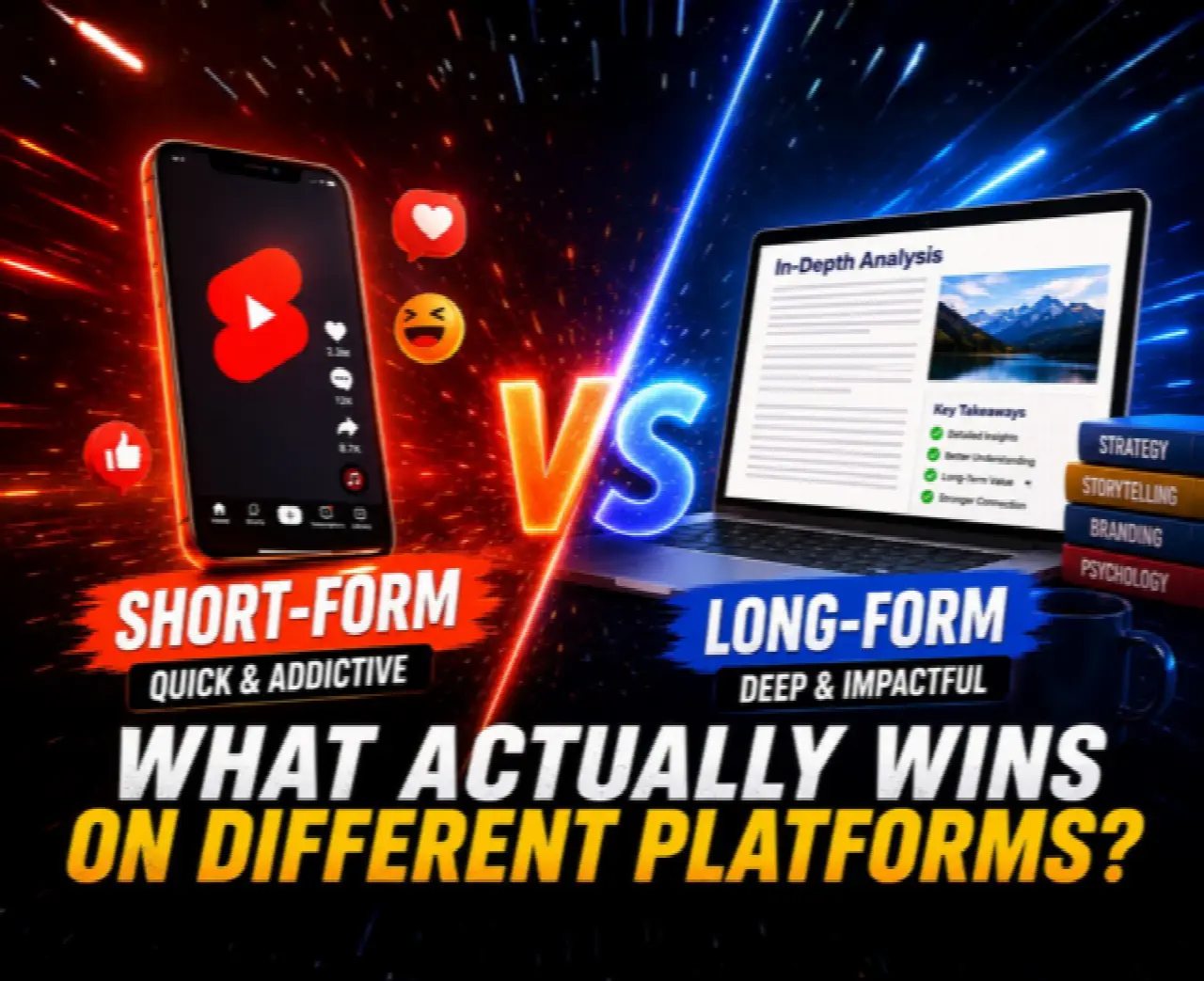
Short-Form vs. Long-Form Content: What Actually Wins on Different Platforms?
We need to stop arguing about whether short-form or long-form content is “better.” The debate is completely dead.
Think about it: a 60-second video that racks up 10 million views is basically useless to a business if it doesn’t bring in a single customer. On the flip side, a 2,000-word blog post that only gets a few hundred readers—but converts them at 8%—is an absolute goldmine.
Success today isn't about picking a side. It’s about knowing exactly what your audience expects on each specific platform, and giving it to them in the right format.
INSTAGRAM REELS & TIKTOK
The Verdict: Short-Form Wins (But You Must Entertain)
If you want to grab attention globally, Instagram Reels and TikTok are where you start. But the rules of engagement are ruthless.
You have about 15 to 60 seconds to make an impact. The algorithm rewards completion rates and shares, meaning if people swipe away after three seconds, your video is dead.
What actually works: trend-jacking, popular audio, and posting at a high frequency. Interestingly, highly polished production often performs worse than raw, smartphone-shot footage.
How Chipotle Won the Feed
Chipotle Mexican Grill stopped trying to sell directly. Instead of ads, they posted food hacks, employee challenges, and user-generated content.
The result? Massive engagement, millions of views, and increased store traffic—all driven by entertainment-first content.
The e.l.f. Cosmetics Playbook
e.l.f. Cosmetics embraced authentic iPhone-shot tutorials instead of expensive studio productions.
Gen-Z trusts content that feels real. That raw style dramatically lowered customer acquisition costs while building stronger audience trust.
YOUTUBE
The Verdict: Long-Form Wins (But Demands Structure)
YouTube is driven by intent. Users open the platform to learn, research, or watch deep stories.
What actually works:
Storytelling
Deep dives
Tutorials
Structured chapters
MrBeast’s Retention Empire
MrBeast structures videos like movies with constant hooks and momentum.
That retention keeps viewers watching longer, which massively boosts algorithmic reach.
MKBHD’s Authority Engine
Marques Brownlee built authority through detailed, highly structured reviews.
Long-form video creates credibility that short clips rarely achieve.
The Verdict: Long-Form Wins (For Professionals)
LinkedIn audiences expect insight, depth, and expertise.
What works:
Text-heavy posts
Professional storytelling
Business lessons
Industry commentary
The Executive Approach
Satya Nadella focuses on thoughtful leadership insights instead of viral-style content.
Professionals value nuance and expertise over entertainment.
The Gary Vee Pivot
Gary Vaynerchuk found that while short-form clips generated more views, long-form writing attracted higher-quality connections like founders, investors, and executives.
TWITTER / X
The Verdict: Short-Form is Native
Twitter thrives on speed, personality, and cultural relevance.
What works:
Sharp opinions
Humor
Real-time commentary
Short threads
Personality Over Product
Netflix and Wendy's dominate because they sound human instead of corporate.
On Twitter, brand personality is often more important than the actual product.
The Verdict: Long-Form Visual Storytelling Wins
Pinterest users arrive with strong intent. They are planning, researching, and saving ideas.
What works:
Step-by-step visuals
Multi-slide tutorials
Inspirational graphics
Tasty’s Long-Term Traffic Strategy
BuzzFeed built massive Pinterest reach by posting complete visual walkthroughs instead of single images.
Because users save content for later, these posts continue generating traffic for years.
BLOGS & OWNED CONTENT
The Verdict: Long-Form Always Wins
Owned content is your most valuable digital asset because you fully control it.
What works:
2,000+ word guides
SEO-driven articles
Deep educational content
HubSpot’s SEO Engine
HubSpot built an empire by ranking detailed educational content on Google.
Their long-form articles consistently attract high-intent traffic and convert readers into leads.
📊 The Strategy Matrix
Platform | Primary Format | Frequency | Primary Goal |
Instagram / TikTok | Short (15–60s) | 3–5x daily | Awareness & Virality |
YouTube | Long (10–20m) | 1–2x weekly | Authority & Monetization |
Long (300–800 words) | 2–3x weekly | Professional Credibility | |
Twitter / X | Short (280 chars) | 5–10x daily | Real-Time Engagement |
Medium (8–15 slides) | 5–10x weekly | Inspiration & Traffic | |
Your Blog | Long (2,000+ words) | 1–2x weekly | SEO & Lead Generation |
The Winning Hybrid Strategy
The smartest brands don’t choose between short-form and long-form.
They create one major “pillar” piece of content and repurpose it everywhere:
YouTube video
Blog article
LinkedIn insights
Instagram clips
Twitter threads
Pinterest graphics
Short-form content generates attention.
Long-form content builds trust.
Trust creates conversions.
Written by
Udit
Webcooks Team
Keep reading
Related Posts

The Anatomy of Ai Slop: Why Volume-First Marketing is Failing
Why Your YouTube Videos Aren’t Getting Views — YouTube SEO Hacks That Actually Matter in 2026