Why Your Website Isn’t Ranking in Google or AI Search — The 2026 Technical SEO Guide
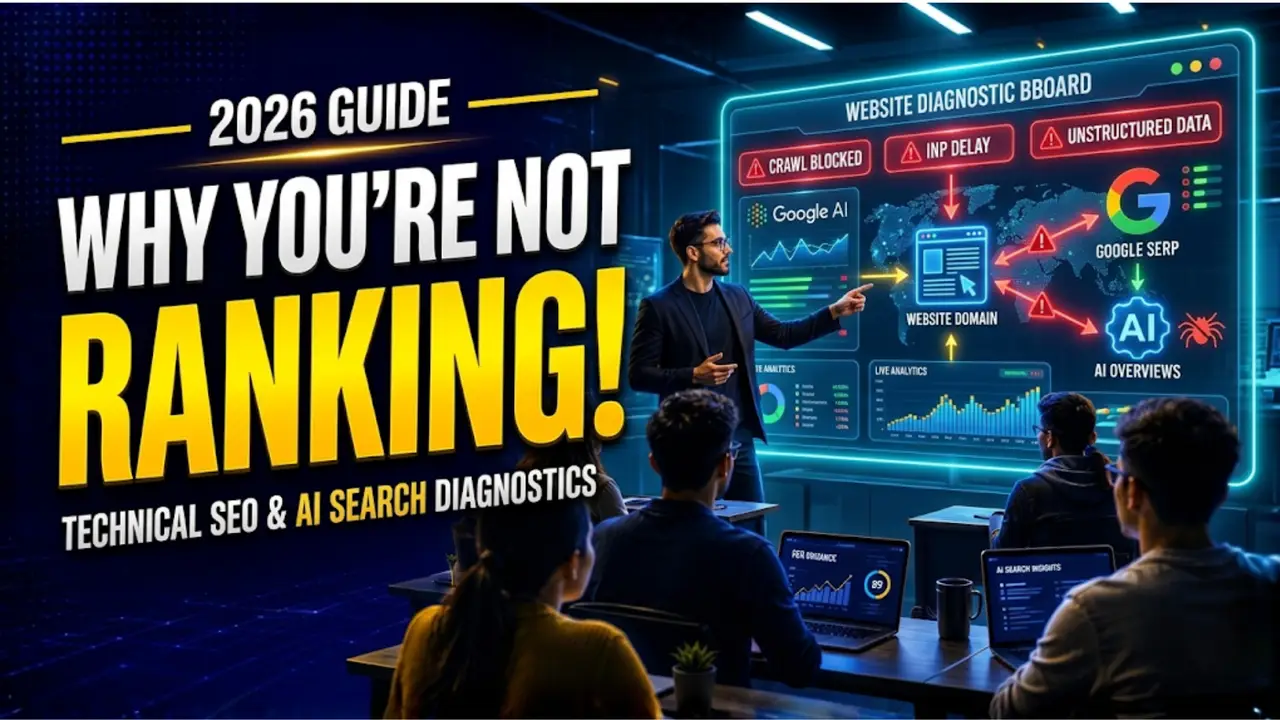
Why Your Website Isn’t Ranking in Google or AI Search — The 2026 Technical SEO Guide
Your pages are indexed. You publish regularly. Your SEO tool says the site is healthy. You may even rank well for several important keywords.
Yet your competitors keep appearing in Google’s AI answers. ChatGPT mentions other brands. Important pages take too long to surface, and content you consider better than the competition gets ignored.
So what are you missing?
Search visibility in 2026 is no longer only about keyword → page → ranking.
Modern search systems also need to discover your content, render it correctly, understand what it represents, retrieve the right information from it and find enough evidence to trust it.
That creates four important questions:
Can machines understand your website?
Can they access and process it efficiently?
Can AI systems retrieve useful answers from your content?
And can your expertise be independently trusted?
If one of these layers breaks, publishing another 2,000-word article may not solve the problem.
Let's diagnose each one.
1. Why Search Engines and AI Crawlers Struggle to Understand Your Website
Imagine entering a warehouse containing 50,000 unlabelled boxes.
Everything you need might be inside.
Finding it is another matter.
Websites create a similar problem when important information exists visually but its meaning and relationships aren't sufficiently clear.
Suppose an ecommerce page displays:
Running Shoe X
₹8,999
In Stock
4.7/5 from 430 reviews
A human immediately understands the relationships.
Structured data can make those relationships more explicit to machines:
Product → Brand → Offer → Price → Availability → Rating
Google documents structured data as a mechanism for helping it understand page content and making eligible pages available for certain search appearances.
But here's the mistake:
"We'll add schema and rank higher."
Schema isn't a ranking cheat code.
Think:
Schema → clearer machine understanding
not:
Schema → guaranteed rankings
What about AI crawlers?
The same principle applies to AI systems.
OpenAI, for example, distinguishes between crawler identities such as GPTBot and OAI-SearchBot.
That means blindly blocking every AI-related user agent—or allowing everything without understanding it—isn't a technical strategy.
Your server logs can answer something more useful:
Are these crawlers actually requesting your pages?
Check:
which URLs they request,
HTTP response codes,
crawl frequency,
blocked resources,
duplicate URLs being crawled.
If an important research page repeatedly returns 403 to a crawler, that is actionable evidence.
And llms.txt?
The proposed llms.txt convention has attracted significant attention because it offers machine-friendly guidance about important website resources.
It may be particularly logical for complex documentation websites containing APIs, SDKs, tutorials and multiple versions.
But don't confuse:
making information easier to discover
with:
giving information authority.
Creating /llms.txt doesn't automatically make a local business the preferred recommendation in an AI answer.
A machine can access your content and still decide not to use it.
Ask yourself
If your website's visual design disappeared and a machine received only its content, links, metadata and structured information:
Would it confidently understand who you are, what you offer and what each important page represents?
If not, start there.
2. Why Website Performance Is Hurting Rankings and Crawlability
Your developer opens the homepage.
It loads instantly.
"The website is fast."
But your customers may be using mid-range Android devices on mobile networks while analytics, chat widgets, advertising scripts and consent tools compete for browser resources.
Whose experience should you optimize?
Google's Core Web Vitals currently focus on:
LCP — loading performance.
INP — interaction responsiveness.
CLS — visual stability.
Recommended "good" thresholds include LCP within 2.5 seconds, INP within 200 milliseconds and CLS at 0.1 or below.
But there's an important distinction between lab data and field data.
Lighthouse simulates an environment.
CrUX reflects aggregated experiences from eligible real Chrome users.
That explains why Lighthouse might show 95 while Search Console still reports Core Web Vitals problems.
Real brand example: Vodafone
Vodafone published a performance case study through Google's web.dev ecosystem in which an A/B test associated a 31% improvement in LCP with an 8% increase in sales, alongside improvements in other engagement metrics.
Does that mean improving your LCP by 31% guarantees 8% more revenue?
No.
It demonstrates something more useful:
Performance can affect business behaviour, not merely an SEO score.
INP exposes another problem
Imagine your product page loads in 1.8 seconds.
Then a shopper clicks Add to Cart.
Nothing visibly happens for 700 milliseconds.
Is that a fast website?
Technically, it loaded quickly.
Experientially, it feels sluggish.
Common INP problems include:
long JavaScript tasks,
heavy event handlers,
third-party scripts,
excessive DOM work,
framework hydration.
This becomes especially relevant for JavaScript-heavy sites.
Google describes JavaScript processing through stages including:
Crawl → Render → Index
Your server returning HTTP 200 therefore doesn't automatically prove that every important element rendered correctly.
Ask yourself
When your team says:
"Our website is fast,"
ask:
Fast for which user, device, page and interaction?
That question produces a much better performance conversation.
3. Why Great Content Still Gets Ignored by AI Search
Here's where traditional SEO thinking starts to become insufficient.
Historically, we often simplified search into:
Query → Ranking → Click
AI-generated answers introduce another workflow:
Question → Related information needs → Retrieval → Passage selection → Synthesis → Citation
Your entire webpage doesn't necessarily need to become "the answer."
A particularly relevant passage may be what matters.
Evidence from AI Overview citations
Ahrefs' March 2026 analysis examined roughly four million URLs cited in Google AI Overviews.
Only 37.9% of those cited URLs also appeared within the first ten Google result blocks for the corresponding queries in its dataset.
That doesn't mean rankings don't matter.
It means:
Ranking position alone doesn't fully explain AI citation selection.
Query fan-out changes content architecture
Consider:
"What's the best CRM for a small Indian real-estate company?"
Answering that properly may require information about:
CRM pricing,
WhatsApp integration,
lead automation,
real-estate workflows,
team size,
mobile functionality.
One question creates several related information needs.
Now compare two articles.
Article A
The Complete CRM Guide
Four thousand words of continuous generic content.
Article B
Best CRM for Teams Under 10
Which CRMs Integrate With WhatsApp?
CRM Pricing for Indian Businesses
Best CRM for Real-Estate Lead Follow-Up
Article B creates clearer retrieval opportunities.
Not because H2 tags magically create AI citations.
Because distinct questions have distinct answers.
A real SEO experiment
Semrush tested query fan-out optimization across four existing articles by expanding coverage around related information needs.
Tracked citations increased from two to five by the end of its experiment and fluctuated during the test.
Four pages are nowhere near enough to establish a universal ranking law.
But the experiment supports a useful hypothesis:
Covering meaningful related questions creates more opportunities for retrieval.
Ask yourself
Pick your latest article.
Could someone extract a useful answer from each important section without reading the preceding 500 words?
If not, you may be writing for word count rather than retrieval.
4. Why Google and AI Engines May Not Trust Your Content
You can solve crawling.
You can improve performance.
You can structure information perfectly.
But there's still one question:
Why should anyone believe you?
Google's quality framework discusses:
Experience, Expertise, Authoritativeness and Trustworthiness — E-E-A-T.
Google also makes an important clarification: E-E-A-T isn't itself a single specific ranking factor.
There isn't a documented:
E-E-A-T Score: 87/100
Instead, Google's systems use multiple signals related to content quality and trust.
Consider two health articles
Article A
10 Ways to Reduce Cholesterol
Author: Admin.
No biography.
No sources.
No medical review.
Now:
Article B
Identifies the writer, relevant qualifications, medical reviewer, update date and supporting clinical sources.
Which would you personally trust before making a health decision?
This becomes particularly important for YMYL—Your Money or Your Life—topics, where incorrect information could materially affect someone's health, financial stability or safety.
Authority also exists outside your website
Here's an important AI-search development.
Ahrefs analyzed 75,000 brands and reported that branded web mentions showed the strongest correlation among the factors it studied with Google AI Overview brand visibility.
Its reported correlations included:
Branded web mentions — 0.664
Branded anchors — 0.527
Domain Rating — 0.326
Referring domains — 0.295
Backlinks — 0.218
Correlation isn't causation.
But it raises an important strategic question.
Your website saying:
"We are the leading experts."
is a claim.
Independent publications, customers, industry websites and experts repeatedly associating your brand with a subject create external corroboration.
That's why modern authority shouldn't be reduced to backlink quantity.
Ask yourself
If an AI system searched the wider web to verify your expertise, what would it find?
Only claims you've made about yourself?
Or independent evidence supporting them?
The 2026 SEO Framework: Crawl → Understand → Retrieve → Trust
Instead of chasing every new AI SEO tactic, diagnose your site through four stages.
Crawl
Can search engines and relevant AI crawlers efficiently access important content?
Understand
Can machines identify your products, organization, authors and relationships?
Retrieve
Can useful passages answer specific questions without unnecessary context?
Trust
Can your claims and expertise be verified?
Performance supports every layer.
A technically impressive page that takes six seconds to become usable isn't delivering a good experience.
Neither is a lightning-fast page containing weak information.
Run this five-minute audit
Choose one commercially important page and ask:
1. Can crawlers access it without friction?
2. Can machines clearly understand what the page represents?
3. Does every important section answer a distinct question?
4. Are factual claims supported with appropriate evidence?
5. Is the author or organization clearly identifiable?
6. Do credible external sources reinforce your expertise?
7. Are real users getting a good performance experience?
Three or more "No" answers?
Don't immediately publish another article.
Fix the underlying system.
SEO Isn't Dead. Its Surface Area Has Expanded.
AI didn't eliminate SEO.
It expanded the number of places where search visibility can succeed—or fail.
We're moving beyond optimizing only for:
Keyword → Ranking
toward an ecosystem where information needs to be:
Discovered → Understood → Retrieved → Trusted
The objective isn't to write for robots.
It's to make genuinely useful human knowledge easier for machines to interpret without ambiguity.
So the next time someone asks:
"Why aren't we ranking?"
ask something better:
Is this a crawling problem?
An understanding problem?
A retrieval problem?
Or a trust problem?
Once you know which layer is broken, SEO becomes much less mysterious.
And that's exactly what the next four guides in this series diagnose in depth.
Written by
Udit
Webcooks Team
Keep reading