Why Your Content Ranks on Google but Doesn't Appear in AI Answers — GEO & Retrieval SEO Explained
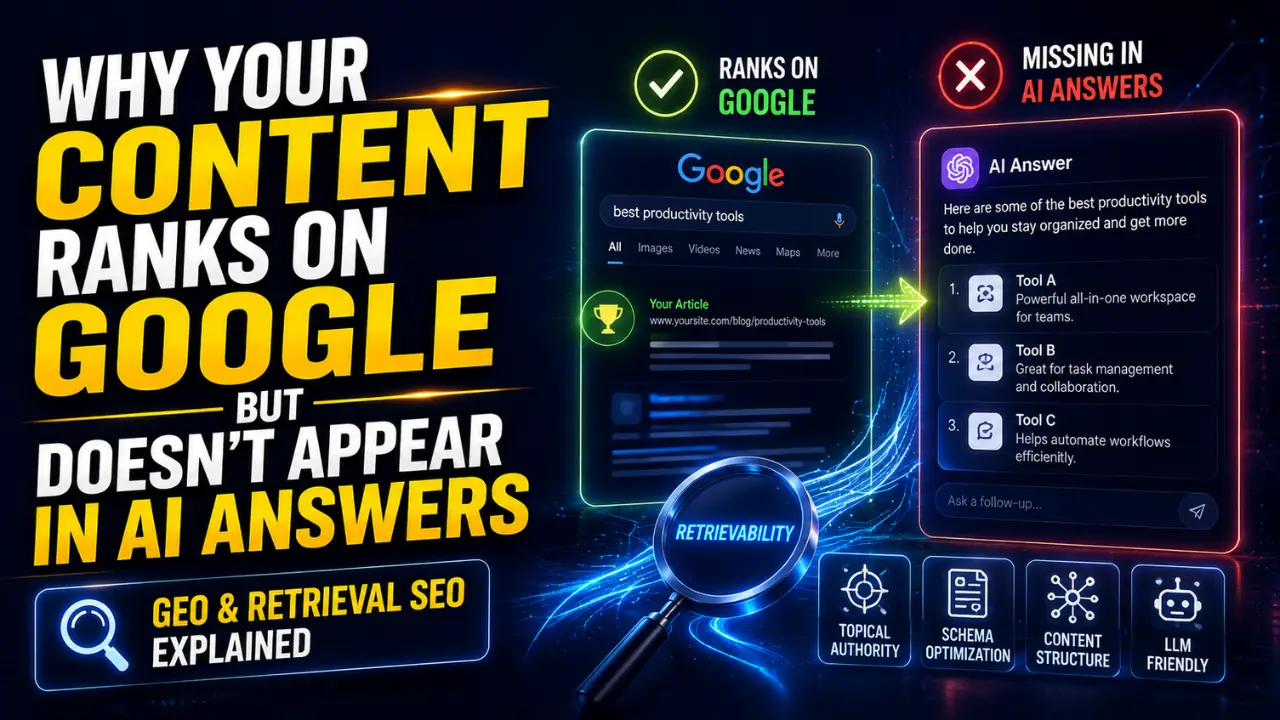
Your article ranks fourth on Google.
You ask an AI search engine essentially the same question.
Three competitors appear.
Your brand doesn't.
How can a page rank organically and still disappear from an AI-generated answer?
Because ranking and retrieval overlap, but they aren't identical.
Traditional SEO asks:
"Can this page rank for the query?"
AI visibility introduces another question:
"Can the system find a passage from this page that is useful enough to contribute to the answer?"
That difference changes how we structure content, build topical authority and measure visibility.
1. Why Traditional SEO Content Isn't Enough for AI Retrieval
SEO has traditionally been simplified into:
Keyword → Page → Ranking → Click
AI-generated answers introduce additional steps:
Question → Related information needs → Source retrieval → Passage selection → Synthesis → Citation
The entire page isn't necessarily the unit being selected.
A useful section may be.
Evidence from Google AI Overviews
Ahrefs' March 2026 analysis looked at approximately four million URLs cited by Google AI Overviews.
Only 37.9% of cited URLs also appeared within the first ten Google result blocks for corresponding queries in its dataset.
This doesn't prove traditional rankings are unimportant.
A substantial overlap still exists.
But it does demonstrate why:
"We're ranking #3, therefore AI should cite us"
is an unsafe assumption.
Consider two articles
Article A:
The Ultimate Guide to Business Loans
Six thousand words.
The documentation required for an Indian business loan appears around paragraph 47.
Article B:
What Documents Are Required for a Business Loan in India?
The next paragraph immediately provides a concise answer.
For that specific information need, Article B provides a cleaner retrieval unit.
This isn't about writing short content.
It's about creating self-contained, semantically clear sections.
Audience test
Open one of your articles and randomly choose an H2.
Read only that section.
Does it make sense without the introduction?
If not, consider whether the section needs stronger context and a more direct opening answer.
2. How Query Fan-Out Changes the Way You Structure Content
Consider:
"What's the best CRM for a small real-estate business in India?"
One question.
But answering it might require research into:
CRM pricing in India,
WhatsApp integration,
lead automation,
mobile access,
real-estate workflows,
team limits,
reporting,
implementation complexity.
This expansion into related information needs is commonly described as query fan-out.
Old content approach
Primary keyword:
best CRM
Then repeat it throughout 3,000 words.
Retrieval-oriented approach
Map the decision.
Best CRM for Small Real-Estate Teams
CRM Pricing in India
Which CRM Integrates With WhatsApp?
Best CRM for Property Lead Follow-Up
CRM Setup and Training Costs
Now one page can satisfy multiple related information needs without becoming repetitive.
Semrush's real experiment
Semrush tested this idea across four existing articles.
It identified relevant fan-out questions and expanded content to address them.
Its tracked citations increased from two to five by the end of the experiment and fluctuated during the month.
That's interesting—but four URLs don't prove a universal ranking mechanism.
What the experiment provides is a testable content strategy:
Map the questions surrounding a decision, then answer the genuinely useful ones clearly.
Try this yourself
Take your main keyword.
Ask:
What does someone need to know before this question?
What would they ask immediately afterwards?
What comparisons affect the decision?
What constraints change the answer?
Those questions often reveal better content opportunities than another keyword-volume export.
3. How to Write Content AI Systems Can Retrieve and Cite
Retrieval-friendly content doesn't mean robotic writing.
It usually means better writing.
Compare:
"In today's rapidly evolving digital environment, businesses around the world are increasingly looking for innovative methods to enhance website performance."
with:
"INP measures how quickly a webpage responds visually after user interaction. Google recommends 200 milliseconds or less for a good experience."
Which paragraph answers something?
The second.
Use answer-first structure
For important informational sections:
Question
↓
Direct answer
↓
Evidence
↓
Example
↓
Explanation
↓
Limitation or nuance
This structure helps humans scan while creating semantically coherent passages.
Increase semantic density
Semantic density isn't about stuffing entities.
It's about reducing empty sentences.
Weak:
"Structured data is increasingly important in today's modern SEO environment."
Useful:
"Product structured data can identify price, availability, ratings and offers, giving Google explicit information about ecommerce products."
Every paragraph should earn its place.
Build entity relationships
Topical authority also isn't:
publish 100 articles containing the same keyword.
Imagine a CRM company.
Its content graph might connect:
CRM
→ Lead Management
→ Sales Pipeline
→ Real Estate
→ Small Business
→ Automation
→ Reporting
→ Pricing
→ Data Migration
Those relationships are more meaningful than:
CRM Guide
CRM Tips
CRM Advice
CRM Trends
CRM Explained
Audience exercise
Highlight every paragraph in your latest article containing:
a direct answer,
fact,
original insight,
example,
evidence.
Everything left unhighlighted deserves scrutiny.
4. Why Third-Party Mentions and AI Visibility Tracking Matter
You can make content perfectly retrievable.
That still doesn't make it authoritative.
AI systems can encounter information about your brand from sources beyond your website.
This is why GEO increasingly intersects with:
digital PR, brand building and entity authority.
Ahrefs' 75,000-brand analysis
Ahrefs examined factors correlated with brand visibility in Google AI Overviews.
It reported:
Branded web mentions — 0.664
Branded anchors — 0.527
Branded search volume — 0.392
Domain Rating — 0.326
Referring domains — 0.295
Backlinks — 0.218
The critical word is:
correlation.
This doesn't prove web mentions cause AI citations.
But it gives marketers an important hypothesis:
Authority may be reflected not only by links, but by how consistently independent sources associate a brand with a subject.
Stop thinking only about backlinks
Ask:
Where should our brand naturally appear when our industry is discussed?
That may include:
trade publications,
expert roundups,
podcasts,
research,
conferences,
communities,
comparison articles,
industry datasets.
Create reasons for those mentions.
Original research is particularly powerful because other writers need sources.
Instead of:
"10 Ecommerce Trends"
consider:
"We Analysed 10,000 Indian Ecommerce Product Pages: Here's What We Found."
Now you possess information someone else may genuinely want to cite.
Measure AI visibility separately
Your SEO dashboard tracks:
Keyword → Position
Add:
Prompt → Mention → Citation → Source → Competitor
For commercially relevant prompts, periodically record:
Are we mentioned?
Are we cited?
Which URL is cited?
Who appears instead?
Which third-party sources support those competitors?
Now GEO becomes something you can investigate.
The goal isn't "writing for ChatGPT."
It's creating information that is:
easy to retrieve, relevant to the question, supported by evidence and associated with an authoritative entity.
That's a much more durable strategy than chasing the latest AI SEO hack.
Written by
Udit
Webcooks Team
Keep reading
Related Posts
The Anatomy of Ai Slop: Why Volume-First Marketing is Failing
Why Your YouTube Videos Aren’t Getting Views — YouTube SEO Hacks That Actually Matter in 2026