How to Build a YouTube Business in 2026: AI, Copyright, Sponsors and Leads
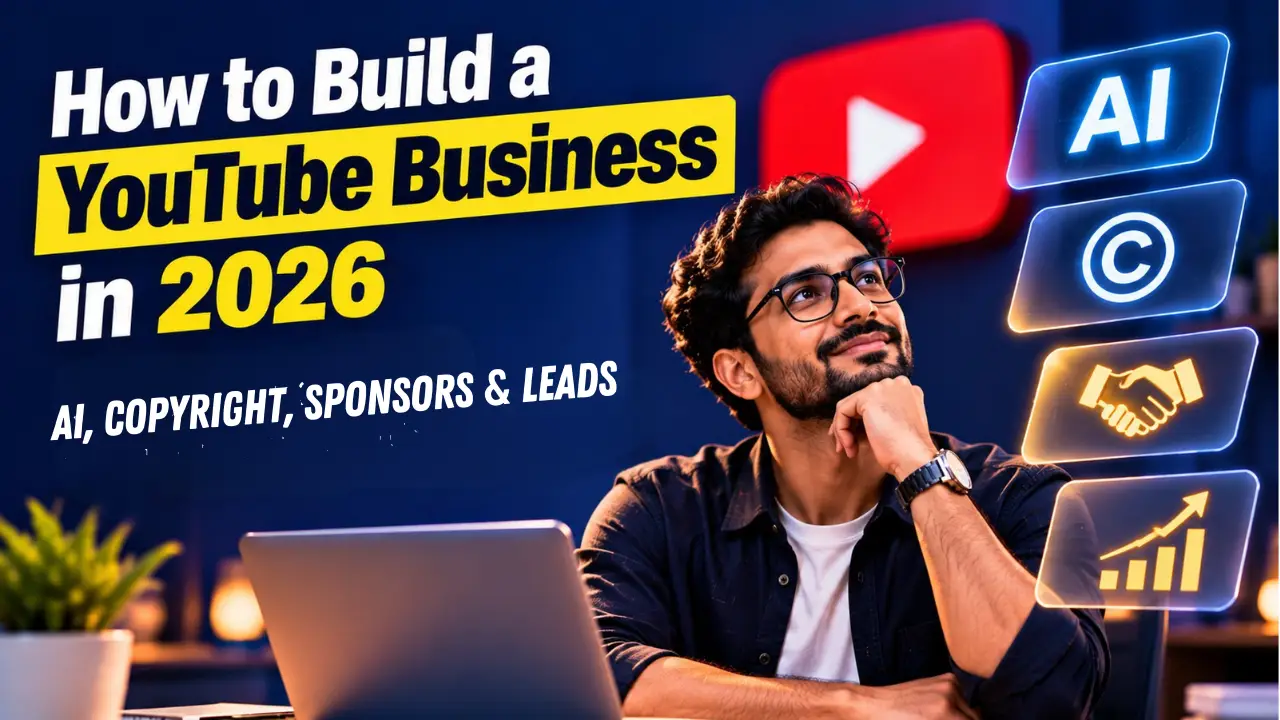
How to Build a YouTube Business in 2026: AI, Copyright, Sponsors and Leads
Open an AI tool.
Ask: “Give me 100 YouTube video ideas.” Done.
Generate a script. Done.
Create a voice. Done.
Generate visuals. Done.
Create captions. Done.
Schedule uploads. Done.
So if practically everyone can produce more content than ever before, here's the uncomfortable question:
Why should anyone watch yours?
AI has dramatically reduced the friction involved in creating content. It hasn't eliminated the need to create something worth watching. In fact, as generic content becomes easier to produce, originality, expertise, evidence, experience and trust may become even more valuable.
And that changes how businesses should think about YouTube.
How to Use AI for YouTube Without Sounding Like Everyone Else
AI can help across almost the entire production workflow. Here is where it helps and where you still have to do the work.
Research: let AI organise, not invent
Use AI to organize information, identify questions and structure research. But don't confuse an AI summary with original research.
If you're making “We Audited 100 Ecommerce Websites”, then audit the websites. Your actual observations are the value. AI can help organize them. It shouldn't invent the evidence.
Ideas: let AI widen, you decide
AI can expand one topic into multiple angles. Take the topic “Local SEO”. Possible angles:
Beginner tutorial.
Mistakes.
Case study.
Experiment.
Myths.
Audit.
Comparison.
Checklist.
Industry update.
That's useful. But human judgment still decides: which one does our audience actually care about?
Scripts: let AI help, add your own voice
AI can help with outlines, alternative hooks, transitions, simplification, examples and counterarguments. But beware of generic AI language. If every video begins “In today's rapidly evolving digital landscape…”, your audience may evolve rapidly toward the Back button.
Add what only you have:
Real opinions.
Personal experience.
Original examples.
Actual failures.
Numbers.
Screenshots.
Experiments.
Customer questions.
That's what makes information yours.
Thumbnails: communicate the promise
AI can help brainstorm thumbnail concepts. But the objective isn't to make an attractive picture. It's to communicate the video's promise instantly. Those are different design problems, and learning the basics of graphic design helps you judge which concept actually works.
Repurposing: reuse the idea, not the size
One strong long-form video can be transformed into Shorts, social posts, newsletter ideas, blog sections, community questions and clips. But repurpose the idea, not merely the dimensions. A 45-second clip should make sense without requiring viewers to watch the previous eight minutes.
Analytics: use AI for hypotheses, then test
AI can also help creators reason through data. For example: “Here are our last 20 videos with impressions, CTR, retention and subscriber conversion. Identify patterns worth investigating.” Useful. But correlation isn't automatically causation. AI can help generate hypotheses. You still need to test them, and our guide on how to read YouTube Analytics shows how.
Your edge: what AI can't copy
Imagine your competitor has the same ChatGPT access, similar editing software, the same stock libraries, similar thumbnail tools and the same public research. What do you have that they don't?
Your experience.
Your customers.
Your experiments.
Your data.
Your perspective.
Your personality.
Your mistakes.
Your evidence.
That's your moat. If you want to learn how to use these tools on real tasks, an AI and automation course is a good place to start.
AI Content, Copyright and Monetization: What Can Go Wrong
This is where speed becomes dangerous.
Two channels that both use AI
Channel A uses AI for research assistance, script structure, captioning, editing assistance and thumbnail ideation. The creator adds original expertise, narration, demonstrations, examples and analysis.
Channel B generates hundreds of highly similar scripts, uses synthetic narration and templated stock visuals, adds little meaningful original value and uploads at scale.
Both “use AI.” They're not the same content strategy. YouTube's monetization policies focus heavily on whether content is original and authentic enough to provide value, rather than being mass-produced or repetitious.
That's why the question shouldn't be “Can I monetize AI content?” It should be: What meaningful original value does this content provide?
Copyright: the internet is not a free library
Creators often assume: “It's on the internet, so I can use it.” No. Music, video clips, images, TV footage, sports footage and other creators' videos can all involve rights.
Another dangerous sentence is: “It's fair use because I used only ten seconds.” There is no universal ten-second rule that automatically makes something fair use. Copyright questions depend on context and applicable law.
Claim vs strike: know the difference
Copyright claims and copyright strikes aren't identical. A claim can affect monetization or how content is handled. A valid takedown can result in a strike and more serious channel consequences. Don't wait until your channel becomes valuable before learning the difference.
Synthetic and altered content: disclose it
Where YouTube requires disclosure for realistic altered or synthetic content, creators should use the relevant disclosure tools. The broader principle is simple: don't use AI to deceive viewers about something material. Trust is difficult to build and very easy to lose.
How to Turn YouTube Viewers Into Leads, Customers and Sponsors
Let's say your company sells digital marketing training. You publish “How to Run Your First Google Ads Campaign” and it gets 20,000 views. What happens next?
If the answer is “Hopefully they subscribe,” you're leaving business value on the table.
Build a value ladder
YouTube video: free education.
Google Ads checklist: a useful downloadable resource.
Email or enquiry: the viewer becomes a lead.
Case study: the viewer sees evidence.
Demo or consultation: the viewer evaluates the offer.
Course: the viewer becomes a customer.
Now the video isn't merely a content asset. It's part of a customer journey.
Use real case studies
Generic claim: “We teach practical digital marketing.” Evidence: “Here's the Google Ads campaign. Here's what we changed. Here's what went wrong. Here's what happened.” Much stronger.
This is why real brand or client case studies can become powerful YouTube content, as long as confidentiality and permissions are handled correctly. Evidence builds trust.
How sponsorships really work
Imagine a B2B analytics company choosing between Channel A, with 500,000 broad entertainment and lifestyle subscribers, and Channel B, with 50,000 marketing professionals, ecommerce owners and analysts. Which audience is worth more? For that advertiser, Channel B may be dramatically more relevant.
That's why sponsorship pricing shouldn't be reduced to subscribers × an arbitrary rate. Brands care about:
Audience.
Geography.
Niche.
Views.
Engagement.
Authority.
Integration.
Campaign objective.
Commercial relevance.
Sponsorships are one of several revenue routes. We covered the others in 8 ways to earn on YouTube beyond AdSense.
Don't trade trust for a sponsor
Suppose you spend two years telling your audience, “I only recommend tools I genuinely use.” Then you promote an obviously poor product because the sponsorship fee is attractive. You've monetized the video, and potentially damaged the asset that made the sponsorship valuable: trust. Short-term revenue can create long-term cost.
Integrate sponsors naturally
A sponsorship shouldn't feel like an unrelated television commercial dropped into the middle of a tutorial. The strongest integrations usually have a logical connection between the audience, the problem, the content and the product. That's better for the viewer, better for the sponsor and better for the creator.
Is Paid Promotion Worth It for Your YouTube Videos?
This is the final misconception we need to address. “My video isn't getting views. Should I run YouTube Ads?” Maybe. But advertising doesn't automatically fix content.
Imagine your video has a confusing thumbnail, a weak opening, poor retention, an unclear audience, no call to action and a weak landing page. Then you spend ₹50,000 promoting it. What have you achieved? You've paid to expose more people to the same problems.
Give paid promotion an objective
Don't advertise because “we want more views.” Ask: what business outcome are we trying to create? Potential objectives include:
Awareness.
Product launch.
Lead generation.
Remarketing.
Event registration.
Course enquiry.
Demo request.
Sales.
Now you can decide whether paid distribution makes sense.
Organic and paid work together
Organic YouTube content earns distribution through viewer interest and platform discovery. Paid campaigns buy access to targeted audiences. They're different systems, and they can complement each other.
For example: you publish a strong case-study video organically. It performs well with your existing audience. You learn that business owners respond strongly to it. Now you create a paid campaign targeting relevant prospects and send them into an appropriate funnel. That's very different from “This video failed organically, so let's buy 100,000 views.”
Remarketing: a more intentional journey
Imagine someone watches your tutorial, visits your website and doesn't enquire. Later they see a relevant case study or offer. That's a more intentional journey than repeatedly showing generic ads to cold audiences. Again: content + audience + funnel + measurement. Everything has to connect.
Measure what matters
If you're paying for distribution, don't celebrate “100,000 views!” until you know what those views produced. Track the metric connected to the objective:
Qualified visits.
Leads.
Registrations.
Sales.
Customer acquisition cost.
Conversions.
Revenue.
Brand lift, where relevant.
The cheapest view isn't automatically the most valuable view. Just as the biggest creator isn't automatically the best sponsor, and the highest CTR isn't automatically the best thumbnail. That's the pattern running through this entire YouTube series: context beats isolated metrics.
Putting the Whole YouTube Series Together
We started this series with a simple problem: why isn't my YouTube channel growing? Eight blogs later, the answer should feel very different. It's rarely one thing. A sustainable YouTube system connects:
Optimize: set up the channel and Studio correctly.
Create: develop content people genuinely want to watch.
Discover: help the right audience find and choose it.
Monetize: build revenue beyond vanity metrics.
Build audience: connect Shorts, Community, long-form, Live and Podcasts.
Earn the click: improve titles, thumbnails and packaging through intelligent testing.
Learn and scale: turn analytics, audience feedback and experiments into future content decisions.
Build the business (this post): use AI intelligently, protect originality, understand copyright, build sponsorships, generate leads and amplify proven content.
That's a very different approach from: upload more videos and hope the algorithm notices. YouTube growth becomes a feedback system:
Create → Measure → Listen → Learn → Improve → Repeat
And the audience stays at the center of it. Because algorithms change. Features change. AI tools change. Formats change. Monetization rules change.
But one question remains remarkably consistent: did you create something valuable enough for the right person to choose, watch, trust and eventually return for?
If the answer keeps becoming “yes,” you're not merely growing a YouTube channel. You're building an audience asset.
Written by
Udit
Webcooks Team